Libya still operates without a unified national military. More than a decade after the collapse of the Gaddafi-era armed forces, the country remains split between competing military structures, regional commands, and armed groups that operate with varying degrees of state affiliation.
The concept of a single Libyan army continues to appear in political agreements and international discussions, but implementation remains limited. In practice, Libya’s security landscape reflects a fragmented system shaped by local power centers, political divisions, and external engagement with different factions.
Understanding whether Libya can build a unified military requires looking beyond formal institutions. It requires examining how authority, incentives, and legitimacy function within the country’s current security environment.
The Collapse of Centralized Military Authority
Libya’s military fragmentation began in 2011, but its roots extend further back. Under the previous political system, the formal military was intentionally kept structurally weak compared to parallel security institutions. Loyalty was distributed across different units and command chains, reducing the likelihood of a unified armed institution independent of political leadership.
When the state collapsed in 2011, the formal military structure disintegrated quickly. Weapons depots, bases, and command centers came under the control of local revolutionary groups and emerging armed factions. Rather than being absorbed into a single transitional institution, these groups retained their identity and developed independent chains of command.
The absence of a strong transitional security framework meant that armed groups became the primary providers of local security. Over time, they gained political relevance and access to state resources, which reinforced their position within the emerging post-revolutionary order.
Competing Military Structures in East and West
Today, Libya’s military landscape is commonly described through the presence of two main centers of power, though in reality the structure is more fragmented.
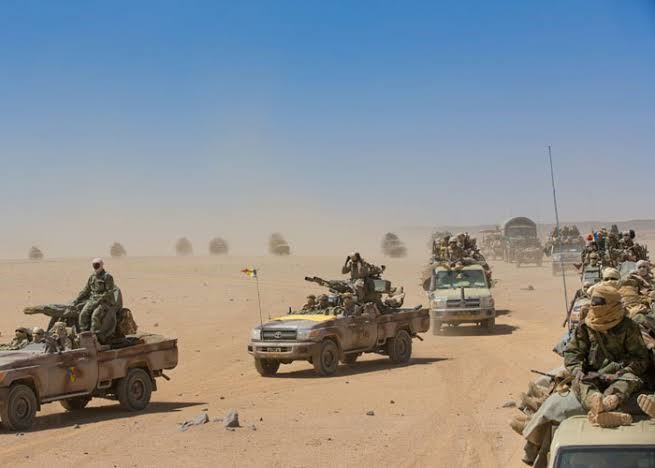
In the east, a consolidated military command structure operates under the leadership of Khalifa Haftar. This force controls large territorial areas, including key strategic zones in the south and east of the country. It functions with a relatively hierarchical command system and maintains institutional cohesion compared to other armed formations in Libya.
In the west, military authority is more decentralized. Armed groups operate in coordination with political institutions in Tripoli, particularly under the Government of National Unity. However, these groups maintain varying degrees of autonomy and often operate based on local alliances, political arrangements, and access to state funding.
While both sides claim legitimacy, they differ in structure and governance approach. The eastern command emphasizes centralized military authority, while western formations operate through a network of semi-autonomous armed groups integrated into political and security arrangements.
This duality creates a persistent barrier to unification, as each structure represents a different model of state authority and military organization.
Militias, Economics, and the Incentive Problem
One of the most significant barriers to military unification in Libya is the role of armed groups as economic actors. Many militias are not only security providers but also participants in formal and informal economic systems.
Some groups receive salaries from state institutions. Others control infrastructure, border crossings, or local trade routes. In certain areas, armed groups provide security services for critical infrastructure, including oil installations, in exchange for financial compensation or political recognition.
This creates a system where armed groups have rational incentives to maintain autonomy. Integration into a unified military structure could reduce their access to independent revenue streams and diminish their local authority. As a result, unification is not simply a technical military process. It is also a redistribution of economic and political power.
State institutions also rely on armed groups for security enforcement. This dependency reinforces the position of militias within the broader governance system, making reform more complex.
Why Previous Unification Efforts Have Stalled
Efforts to unify Libya’s military have appeared in various political agreements and international initiatives over the past decade. However, implementation has consistently lagged behind formal commitments.
One key issue is the lack of trust between competing security institutions. Armed factions on different sides of the political divide often view integration as a potential loss of influence or security. This perception limits willingness to accept unified command structures.
Institutional fragmentation also plays a role. The central defense and interior ministries in Tripoli do not exercise full control over armed groups, while eastern command structures operate independently of western-based institutions. This lack of centralized enforcement capacity makes integration difficult to implement even when agreements exist.
External involvement further complicates the situation. Various international actors engage with different Libyan security structures based on strategic interests. This reinforces parallel systems of legitimacy and reduces pressure for internal consolidation.
Economic incentives also remain misaligned. Without clear mechanisms for compensation, reintegration, or career transition, armed groups have limited motivation to dissolve their independent structures.
External Actors and Parallel Security Support
Libya’s military fragmentation is also shaped by external engagement. Different international and regional actors have supported different security institutions at various stages of the conflict.
This engagement has contributed to the development of parallel military systems, each with its own sources of training, funding, and political recognition. As a result, no single authority has been able to fully consolidate national control over the armed sector.
International efforts through multilateral frameworks have focused on encouraging institutional unification and political settlement. However, these initiatives depend heavily on domestic consensus, which remains limited.
The interaction between domestic fragmentation and external engagement has created a reinforcing cycle. Internal divisions attract external involvement, and external involvement sustains internal divisions.
Is a Unified Military Structure Realistic?
A fully unified Libyan military in the near term appears unlikely. The structural conditions required for rapid integration are not currently present. However, this does not mean that no form of unification is possible.
More realistic outcomes involve gradual and partial integration rather than immediate consolidation. This could include coordinated command arrangements, regional integration of forces, and gradual standardization of training and salary systems.
Some steps toward coordination have already appeared in practice. Local ceasefire arrangements, joint security mechanisms, and limited institutional cooperation suggest that functional coordination is possible under certain conditions.
However, these developments remain fragmented and dependent on local political agreements rather than a national framework.
The Political Dimension of Military Reform
Military unification in Libya cannot be separated from political structure. Armed groups are closely tied to political actors, local governance systems, and access to state resources. As a result, military reform reflects broader questions of political authority and legitimacy.
Without a stable political agreement that defines governance structures, budget distribution, and institutional authority, military integration efforts are likely to remain limited.
In this sense, the military question is not only about security reform. It is also about how Libya defines its political system and how authority is distributed across its territory.
Conclusion
Libya’s military remains fragmented because it reflects a broader fragmentation of political and economic authority. Armed groups operate not only as security actors but also as institutional and economic stakeholders within the state system.
A unified military is not impossible, but it cannot emerge through formal agreements alone. It requires gradual restructuring of incentives, political settlement, and institutional development over time.
At present, Libya is more likely to see incremental coordination rather than full integration. Whether that coordination evolves into a unified national force depends on long-term political stability and the ability of state institutions to gradually reclaim authority over security structures.
For now, Libya’s military landscape remains defined by fragmentation, managed competition, and limited cooperation rather than full unification.