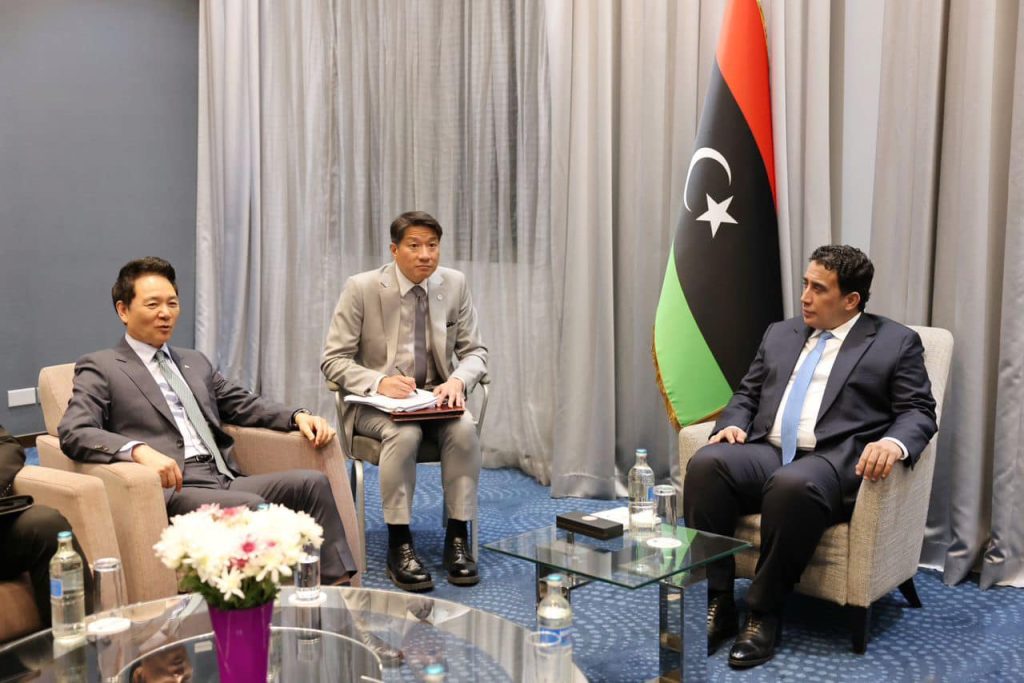
Libya used a high-level Africa–Korea meeting in Seoul this week to position itself within a growing partnership between African states and South Korea, signaling an effort to expand its diplomatic and economic engagement beyond traditional regional relationships. The gathering brought together senior officials from African countries and South Korean counterparts ahead of the first Korea–Africa Foreign Ministers’ Meeting, a forum designed to translate commitments made during the 2024 Korea–Africa Summit into concrete policy initiatives.
The Libyan delegation emphasized cooperation in technology, infrastructure, energy, education, cybersecurity, and artificial intelligence. Officials also highlighted support for the African Union’s Agenda 2063 framework and called for stronger economic integration across the continent through the African Continental Free Trade Area (AfCFTA).
Although the meeting focused primarily on development and economic cooperation, Libya’s participation reflects broader strategic calculations. As international competition for influence in Africa intensifies, partnerships with countries such as South Korea offer Libya opportunities to diversify its external relationships while advancing domestic priorities related to reconstruction, institutional modernization, and economic recovery.
Africa–Korea Partnership Expands Beyond Development Cooperation
The Africa–Korea relationship has evolved significantly in recent years. South Korea has sought a larger role across the African continent through investment, technology partnerships, infrastructure financing, and cooperation on critical mineral supply chains. The 2024 Korea–Africa Summit marked a major step in that effort, bringing together dozens of African leaders and establishing a framework for deeper political and economic engagement.
This week’s ministerial process in Seoul aimed to build on those commitments. According to officials and draft documents discussed during the meetings, participating countries focused on trade, investment, digital transformation, food security, healthcare, climate resilience, infrastructure development, science and technology cooperation, and critical minerals. Delegates also addressed peace and security issues affecting multiple regions across Africa.
For South Korea, the engagement carries both economic and strategic value. African countries possess significant reserves of critical minerals needed for advanced manufacturing, renewable energy technologies, and electric vehicle supply chains. At the same time, Africa represents one of the world’s fastest-growing consumer markets. Seoul has increasingly viewed the continent as an important partner in addressing supply-chain vulnerabilities and supporting long-term economic growth.
In this context, Libya’s participation offers an opportunity to align itself with emerging economic initiatives that extend beyond traditional energy exports. The country’s emphasis on technology transfer, digital development, scientific research, and capacity building suggests a recognition that future competitiveness will depend not only on hydrocarbon resources but also on human capital and technological modernization.
Why Seoul Matters for Libya’s Strategic Outlook
Libya’s delegation highlighted several sectors that closely match the country’s long-term development needs. Infrastructure remains a major priority after years of political instability and underinvestment. Digital transformation and cybersecurity have become increasingly important as Libya seeks to modernize state institutions and expand electronic government services. Energy cooperation also remains central to economic planning as the country continues efforts to increase production and attract foreign investment.
The focus on artificial intelligence and cybersecurity deserves particular attention from a security perspective. Across Africa, governments are investing in digital infrastructure while confronting growing cyber threats targeting public institutions, financial systems, and critical infrastructure. Libya faces similar challenges. Enhanced cooperation with technologically advanced partners such as South Korea could support efforts to strengthen cyber resilience and develop local expertise in emerging technologies.
The discussions also touched on regional economic integration through AfCFTA, a project that seeks to create the world’s largest free-trade area by number of participating countries. For Libya, deeper integration into African markets could reduce economic dependence on a narrow range of export sectors while creating opportunities for trade, logistics, and investment across the continent.
At a geopolitical level, Libya’s engagement with the Korea–Africa framework reflects a broader trend among middle powers and emerging economies seeking greater influence in Africa. Competition for partnerships on infrastructure, energy, critical minerals, and technology increasingly involves countries beyond the traditional Western powers. South Korea, Japan, Turkey, Gulf states, China, and India have all expanded their engagement across the continent in recent years.
Economic Diplomacy and Security Interests Converge
While the Seoul meetings centered on economic cooperation, the distinction between economic and security policy has become increasingly blurred. Infrastructure projects, digital networks, energy investments, and technology partnerships now carry strategic implications that extend beyond commercial interests.
For Libya, attracting investment and technical expertise remains essential to stabilizing the economy and strengthening state institutions. Economic recovery continues to play a critical role in reducing structural vulnerabilities that contribute to political instability. International partnerships that support job creation, infrastructure rehabilitation, and skills development can therefore have indirect security benefits as well.
The inclusion of critical minerals, energy security, supply chains, and digital transformation in the Seoul discussions reflects the changing nature of international competition. Governments increasingly view access to resources, technology, and resilient supply networks as matters of national security. The Korea–Africa partnership framework aims to address many of these challenges through coordinated economic engagement.
Libya enters these discussions from a unique position. The country remains one of Africa’s most significant energy producers while also occupying a strategic location linking North Africa, the Mediterranean, and the Sahel. As international interest in African markets and resources continues to grow, Libya may seek to leverage both its geographic position and resource base to secure a larger role in emerging regional and intercontinental partnerships.
The Seoul meeting alone will not transform Libya’s economic trajectory or diplomatic standing. However, it demonstrates an effort by Libyan officials to engage with evolving international frameworks that could shape future investment, technology cooperation, and regional integration.