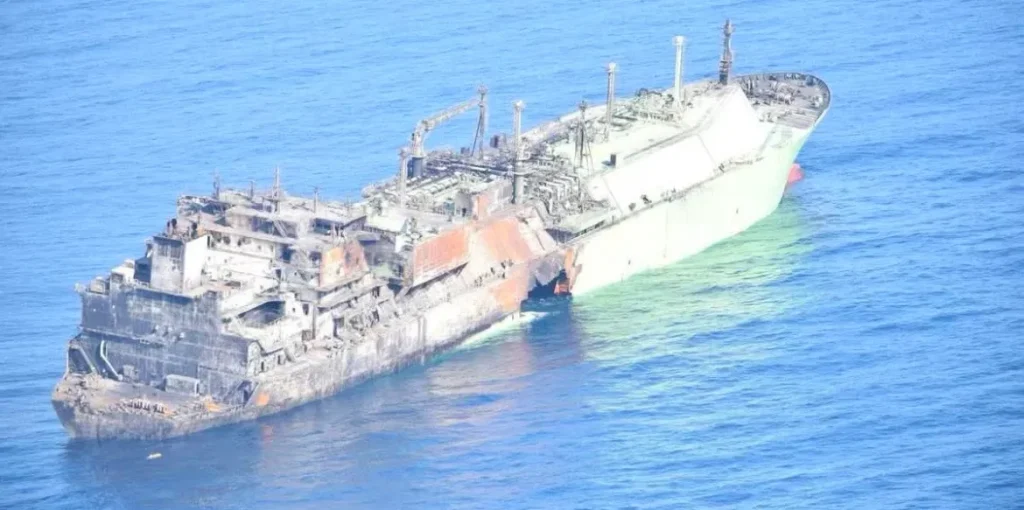
The drifting Russian LNG tanker Arctic Metagaz has turned into more than an environmental and logistical incident. It has exposed a less discussed but increasingly important part of Libya’s security landscape: maritime vulnerability. After the damaged vessel entered Libya’s search and rescue zone in March 2026, Libyan authorities moved to coordinate a response with the National Oil Corporation, the coast guard, and foreign partners to prevent a possible spill near the western coast. Reuters reported that Libya’s coast guard began towing the tanker away from its shores after weeks of drift, while AP noted that the vessel had posed a serious threat to one of the Mediterranean’s more fragile coastal areas.
The incident did not originate as a Libyan security crisis. But once the tanker entered waters under Libyan responsibility, it quickly became one. That shift matters. It shows how Libya’s maritime space can become entangled in wider geopolitical conflict, energy disruptions, and environmental risk even when the original trigger lies elsewhere. For Libya, the real significance of the Arctic Metagaz episode lies in what it reveals about coastal governance, emergency response, and the security value of maritime capacity.
A Security Issue, Not Only a Marine Incident
The immediate concern around the Arctic Metagaz centered on environmental damage. Italian officials warned that the unmanned vessel was only days away from Libya’s coast, while maritime and energy authorities raised concerns about leakage and instability. Reuters reported that the vessel had drifted unmanned for weeks after the incident in early March, prompting Libya’s National Oil Corporation to hire a specialist firm and coordinate with Russian and Maltese authorities.
But maritime incidents of this kind also carry a security dimension. A damaged tanker drifting toward critical coastline infrastructure creates pressure on state institutions, tests interagency coordination, and exposes any weakness in coastal monitoring. Libya did not face a conventional naval threat in this case. It faced something more complex: a cross border maritime emergency with direct consequences for its coastal security environment.
That matters because maritime security no longer depends only on guarding against hostile vessels or trafficking routes. It also depends on a state’s ability to detect, manage, and contain offshore disruption before it turns into a wider crisis.
Libya’s Coastal Role Is Growing
For years, most discussion of Libya’s security challenges has focused on land based conflict: armed groups, border instability, internal political fragmentation, and the southern corridor linking Libya to the Sahel. The Arctic Metagaz incident reminds us that Libya’s coastline is also strategic.
Libya sits along one of the Mediterranean’s most sensitive maritime spaces. Its western coast lies close to migration routes, offshore energy infrastructure, commercial sea lanes, and the maritime interests of southern Europe. When a drifting LNG tanker entered Libya’s search and rescue zone, it did not just create a technical challenge. It placed Libya at the center of a wider chain of regional concern involving Italy, Malta, environmental risk, and maritime coordination. AP reported that Libyan authorities worked alongside Italy’s Eni and the National Oil Corporation to move the tanker toward a safer zone and avert a spill.
This underlines a broader point. Libya’s maritime role is growing, whether or not the country has fully prepared for it. Events at sea can now shape Libya’s security environment as directly as events on land.
Capacity, Coordination, and State Presence
One of the most important aspects of the Arctic Metagaz episode is that it offered a practical test of Libyan response capacity. Reuters reported that the GNU said the National Oil Corporation was handling the cargo and coordinating with foreign authorities to ensure maritime safety, while the coast guard took the visible operational lead in towing the vessel away from shore.
That response suggests a degree of functional coordination that often receives less attention in discussions of Libya. The country’s institutions remain fragmented in many areas, but this episode showed that Libyan actors can still mobilize around a specific coastal threat when the stakes are high enough.
At the same time, the incident also exposed structural limits. Libya’s maritime security architecture remains underdeveloped when compared with the complexity of the risks it faces. Emergency response depended in part on outside technical coordination and on ad hoc crisis management rather than on a deeply institutionalized national maritime framework. That does not negate the response. It simply shows that Libya’s ability to manage maritime incidents still rests on a narrow margin between institutional function and external support.
The Shadow Fleet Dimension
The Arctic Metagaz also adds another layer to Libya’s maritime environment because of the vessel’s broader geopolitical context. Reuters and AP both described it as part of Russia’s sanctioned “shadow fleet,” a network of vessels involved in transporting fossil fuels under increasing international scrutiny.
That detail matters for Libya because it shows how the country’s coastal zone can be affected by sanctions evasion, energy conflict, and contested maritime commerce even when Libya itself is not the central actor. In other words, Libya does not need to become an active maritime confrontation zone to feel the consequences of wider conflicts. Its geography alone makes exposure likely.
This is where the incident becomes relevant from a security perspective. The challenge is not only one damaged ship. The challenge is a maritime environment in which environmental risk, shadow shipping, offshore energy concerns, and international conflict can overlap near Libya’s coast.
Why This Matters for Security Policy
The policy lesson from the Arctic Metagaz incident is straightforward. Libya needs to treat maritime security as part of national security, not as a secondary technical matter. That means investing in coastal monitoring, emergency response systems, interagency coordination, and stronger links between maritime authorities and national security planning.
This does not require Libya to adopt a militarized approach to the sea. It requires Libya to recognize that coastal security now includes environmental protection, energy infrastructure resilience, maritime domain awareness, and crisis response.
The issue is especially relevant for western Libya, where ports, offshore facilities, and key coastal communities remain exposed to regional disruptions.
Analytical Outlook
The Arctic Metagaz crisis did not reveal a new military threat off Libya’s coast. It revealed something more important: Libya’s maritime space has become an increasingly exposed front line of regional insecurity. Energy routes, environmental hazards, geopolitical conflict, and weak maritime governance now intersect close to Libyan waters.
Libya’s response showed that some institutional coordination is possible under pressure. But it also showed that maritime risk management remains reactive rather than fully developed. The significance of this episode lies less in the tanker itself than in the warning it provides. Libya’s security challenges are no longer confined to the battlefield, the capital, or the southern borderlands. They are also unfolding at sea.