Recent reporting has raised renewed concerns about the Islamic State’s presence in Libya, not through visible territorial control, but through quieter forms of activity embedded in trafficking and smuggling systems. Analysis published in March 2026 suggests that ISIS has adapted its approach, relying less on overt military expansion and more on integration into existing illicit networks.
This shift does not indicate a return to the conditions seen in Sirte in 2015–2016. It points instead to a different model of presence, one that operates below the threshold of immediate confrontation while maintaining long-term relevance.
From Territorial Control to Network Embedding
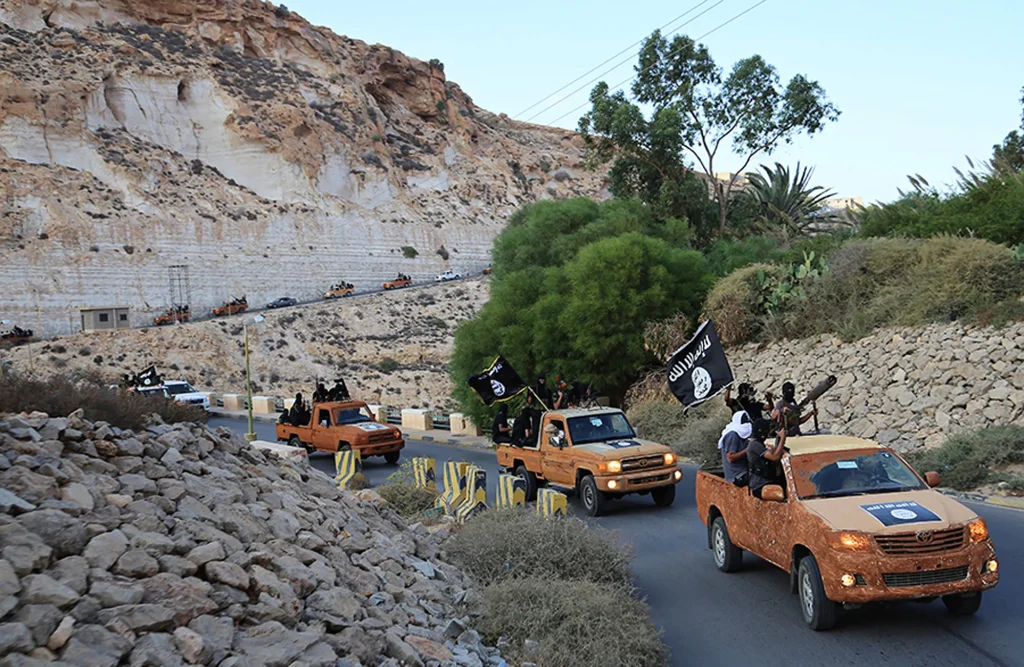
ISIS once controlled territory in Libya, most notably in Sirte, where it attempted to establish a regional stronghold before Libyan forces dismantled it in 2016.
Since then, the group has not reestablished territorial dominance. Instead, it has adapted to Libya’s fragmented environment. Rather than holding ground, it has focused on mobility, survival, and network building.
Recent reporting highlights a growing relationship between extremist elements and human-smuggling networks operating across Libya. These networks provide logistical pathways that allow movement across borders, access to funding streams, and opportunities to operate with limited visibility.
This shift reflects a broader pattern seen in other regions. Extremist groups increasingly embed within criminal economies rather than attempting to control territory outright.
Smuggling as a Strategic Enabler
Smuggling networks in Libya operate across multiple sectors, including migration, fuel, and goods trafficking. These networks stretch from the southern borderlands to coastal departure points in the north. They rely on informal routes, local intermediaries, and cross-border coordination.
For extremist groups, these systems offer several advantages. They provide access to transportation routes, financial resources, and cover within larger flows of people and goods. Reports indicate that such networks may facilitate the movement of individuals linked to extremist organizations across Libya and into neighboring regions.
There is also evidence that extremist elements have historically intersected with trafficking systems in Libya, including involvement in migrant smuggling and related activities.
This does not mean that all smuggling networks are linked to extremist groups. It means that the overlap between criminal and extremist activity creates opportunities for cooperation at certain points.
Why Southern Libya Remains Central
Southern Libya plays a key role in this dynamic. The region connects Libya to the Sahel and sub-Saharan Africa through a network of routes that remain difficult to monitor consistently.
These corridors allow the movement of people, goods, and armed actors across vast and often ungoverned areas. They also link Libya to wider regional instability in countries such as Mali, Niger, Chad, and Sudan.
Security assessments have long warned that extremist groups could exploit these routes to move fighters and resources.
The concern is not that southern Libya is becoming an extremist stronghold. It is that it functions as a logistical corridor within a broader regional system.
A Low-Visibility Threat Environment
The current pattern of activity differs from previous phases of extremist presence in Libya. ISIS no longer seeks to control cities or hold visible territory. Instead, it operates through small cells, informal networks, and opportunistic alliances.
This creates a low-visibility threat environment. Large-scale attacks remain limited, but the underlying networks persist. These networks can adapt quickly, move across regions, and operate without drawing sustained attention.
This type of presence does not generate immediate crisis. It creates long-term security pressure.
Fragmentation and Opportunity
Libya’s internal security structure continues to shape this environment. Armed groups operate alongside formal institutions, and coordination across agencies remains uneven. This fragmentation does not necessarily create instability in every context. But it does leave gaps.
These gaps matter for counterterrorism. Detecting network-based activity requires consistent intelligence sharing, coordination across regions, and sustained monitoring. Where these elements remain uneven, networks can persist.
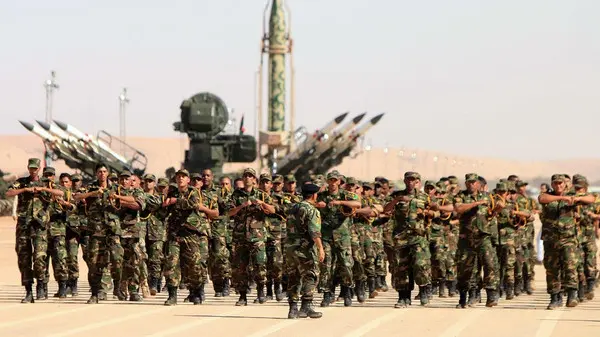
Libyan authorities have conducted operations targeting both smuggling networks and extremist elements. Forces such as the Joint Operations Force have arrested individuals linked to ISIS and disrupted trafficking routes in recent years.
Regional Implications
The overlap between smuggling and extremist activity extends beyond Libya’s borders. Networks that operate inside Libya often connect to routes leading into North Africa, the Sahel, and Europe.
This raises a broader regional issue. Libya does not function in isolation. It forms part of a wider system of movement and exchange that includes both legal and illicit flows.
The concern is not only about activity inside Libya. It is about how networks that operate within Libya can facilitate movement across regions.
Analytical Outlook
Recent reporting on ISIS activity in Libya points to adaptation rather than resurgence. The group has not returned as a territorial force. It has repositioned itself within existing systems of mobility and exchange.
This shift carries important implications. It suggests that the main security challenge is no longer visible control of territory, but the persistence of low-profile networks embedded in broader structures.
For Libya, this reinforces a key point. Security depends not only on controlling territory, but on managing systems. Smuggling routes, cross-border corridors, and informal economies now play a central role in shaping risk.
If current patterns continue, extremist activity in Libya is likely to remain limited in scale but persistent in form. The challenge will not be large-scale confrontation. It will be long-term containment.