The drone that reached a fuel depot on Tripoli’s Airport Road last week arrived at an awkward moment for Libya. Days earlier, the country’s rival political camps had endorsed the 4+4 framework, reviving the prospect of a unified executive authority and elections. Then, on September 3, an unmanned aircraft entered the airspace of a strategic fuel facility in the capital and crashed near storage tanks.
The timing makes the political interpretation almost unavoidable. The Libya Observer has argued that the incident could signal the beginning of a struggle over the political order that emerges from the 4+4 process.
That possibility deserves attention. But it also risks putting the political transition at the centre of a security problem that may be considerably broader.
The more worrying interpretation is not necessarily that someone has begun a coordinated campaign against the post-4+4 order. It is that Libya has reached a point where armed actors can threaten critical infrastructure with relatively inexpensive technology while the state still lacks a unified system capable of preventing, attributing and responding to such attacks.
That is a much deeper problem than one drone over one depot.
The Attribution Problem
The first mistake in analyzing the incident would be to confuse timing with evidence. The drone appeared only days after the 4+4 agreement. That coincidence matters, particularly in a country where political negotiations, armed groups and control over state resources have remained closely connected. But there is still no public evidence establishing who launched the drone, what target the operator intended to hit, or whether the attack formed part of a wider political strategy.
The available facts tell us something important, but not everything.
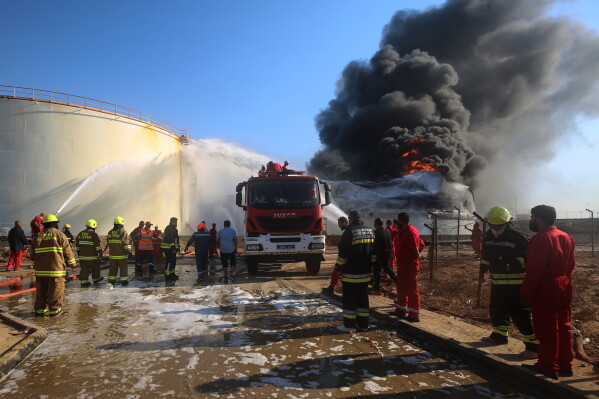
Brega Petroleum Marketing Company said the suspected drone entered the depot’s airspace and fell near a fuel tank. No casualties occurred and fuel distribution continued. The National Oil Corporation later said debris damaged pipelines and two storage tanks and ordered precautionary measures, including reducing fuel levels in affected tanks.
That is enough to establish a serious security breach. It is not enough to establish the identity or political objective of the attacker.
Libya has a long history of turning ambiguous security incidents into political narratives before investigators have established the facts. Once an incident acquires a political explanation, every subsequent development tends to reinforce that explanation, even when alternative possibilities remain.
The drone may indeed represent an attempt to influence the political transition. But Libya’s security environment offers several other possibilities: local armed competition, criminal activity, economic coercion, sabotage, foreign involvement or an actor seeking simply to demonstrate its ability to penetrate a sensitive facility. The uncertainty itself is a security failure.
From Zawiya to Tripoli
What makes the Tripoli incident more significant is not necessarily its connection to 4+4. It is the fact that it followed a series of much more destructive attacks against energy infrastructure in western Libya.
Zawiya experienced repeated drone attacks in August, including strikes against fuel storage tanks. The National Oil Corporation described the August 11 attack as the fifth drone attack against the Zawiya oil complex. Reuters reported that the attacks had become serious enough for the NOC to warn that continued strikes could force it to declare force majeure.
That changes the analytical picture.
If the Tripoli incident stood alone, it would be reasonable to treat it primarily as an isolated security breach. Coming after repeated attacks against Zawiya, however, it suggests that Libya’s energy infrastructure has entered a more dangerous security environment.
The geographical shift matters. Zawiya is already associated with intense competition between armed groups and longstanding instability. Tripoli is different. An attack on a fuel depot in the capital demonstrates that the vulnerability extends into the country’s central political space.
The attacker did not need to destroy the depot to achieve something strategically useful. Reaching it was itself a demonstration. That is where Libya’s security problem becomes more serious than the immediate political debate surrounding 4+4.
The State Has a Different Problem
Libya’s critical infrastructure has traditionally depended on physical protection: guards, checkpoints, armed formations and local security arrangements. Those mechanisms become much less effective when the threat comes from above.
A drone can cross a perimeter without negotiating a checkpoint. It can strike at a time chosen by its operator, create uncertainty about responsibility and disappear before conventional security forces can respond.
The technology therefore exploits precisely the weaknesses that have defined Libya’s security system for years.
There is no single national security command with uncontested authority across the country. There are competing institutions, armed groups with varying degrees of formal affiliation and local security arrangements that often depend on political relationships rather than a unified national doctrine.
That fragmentation creates a particularly dangerous environment for critical infrastructure. The NOC can demand greater protection. Brega can raise its emergency readiness. Security authorities can deploy more personnel around a facility. But none of those measures resolves the underlying question: who controls the airspace above Libya’s strategic infrastructure, and who has the authority to respond when an unidentified aircraft enters it?
Until the state can answer that question, a fuel depot will remain vulnerable regardless of which political faction eventually controls the executive authority.
The 4+4 Test Is Different
This is where the drone incident does connect to the 4+4 process, but perhaps in a different way than the immediate political interpretation suggests.
The real test of 4+4 will not simply involve whether rival political actors can agree on a new executive authority. It will involve whether that political authority can exercise meaningful control over the security environment it inherits.
That distinction is crucial.
A unified government without unified security institutions could inherit the same vulnerabilities that exist today. It could have control over ministries, budgets and diplomatic recognition while armed groups retain the ability to determine what happens on the ground. In that context, the political transition would change the people sitting around the table without fundamentally changing the balance of coercive power.
The drone attacks expose precisely this weakness.
If a future government cannot reliably protect an oil depot, refinery, power station or airport from a relatively small unmanned aircraft, then its claim to national authority will remain incomplete.
This is why the response to the drone threat should not become another contest between political camps over who controls security forces. Libya needs a national critical-infrastructure security framework that brings together intelligence, airspace monitoring, facility protection and rapid response under clearly defined chains of command.
Without that, every attack will generate another round of accusations without necessarily producing greater security.
The Danger of Reading Too Much Into One Drone
There is a temptation to describe the September 3 incident as the opening shot of the struggle for post-4+4 Libya.
Perhaps it was. But Libya does not need to prove that interpretation for the incident to become strategically important.
The more immediate warning is that the country’s critical infrastructure now faces a threat that its fragmented security system struggles to contain. The Zawiya attacks demonstrated that repeatedly. The Tripoli incident brought the problem into the capital.
The political transition may eventually provide Libya with a stronger state. But political agreements do not automatically produce state capacity.
That capacity has to be built. The danger, therefore, is not simply that one faction might try to sabotage the 4+4 process. It is that Libya could enter its next political phase with the same fragmented security architecture that has allowed armed actors to challenge state authority for years.
In that sense, the drone over Tripoli was not necessarily the beginning of the battle for post-4+4 Libya. It may have exposed the battlefield that already exists.