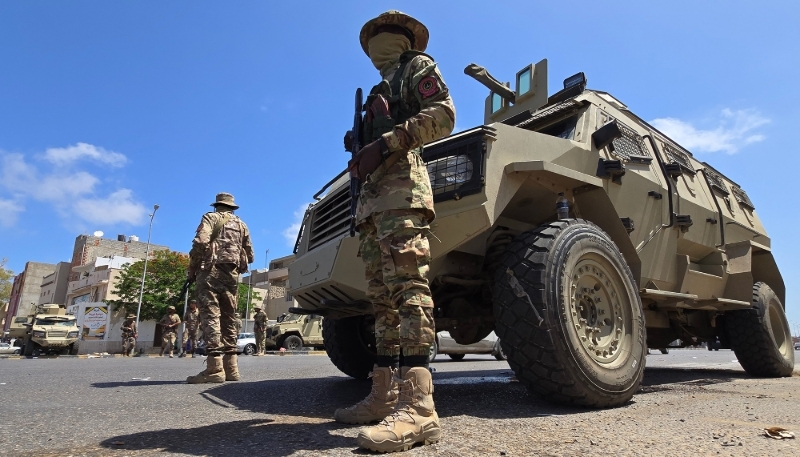
In Tripoli, control over strategic infrastructure often reveals more about real power than formal government decrees. Few sites illustrate that more clearly than Mitiga Airport, where authority has long rested not simply with state institutions, but with armed actors able to enforce their presence on the ground. That reality remains central to understanding the role of the Special Deterrence Force, known as Rada, in 2026.
Recent tensions between Rada and the Government of National Unity, particularly around Mitiga and adjacent security facilities, have underlined a broader problem in western Libya’s security order. Despite repeated claims of state consolidation in the capital, one of Tripoli’s most influential armed groups continues to operate with substantial autonomy. Formally linked to state institutions, Rada is nonetheless not fully subordinate to them. Its position reflects a pattern that has defined Libya’s post 2011 security landscape: governments have sought to manage armed groups through accommodation and selective incorporation, but have struggled to establish a unified chain of command.
As Libya enters another politically sensitive period, with renewed attention on institutional reform and possible elections, Rada’s continued autonomy offers a useful case study in the limits of state control in Tripoli.
The Mitiga Question
The latest tensions surrounding Rada centered on Mitiga Airport, Tripoli’s main functioning airport and one of the capital’s most sensitive strategic sites. Mitiga is more than a transport hub. It is tied to mobility, detention, intelligence, and operational control. Whoever maintains influence there holds significant leverage within the city.
Rada has long maintained a strong presence at Mitiga, along with influence over nearby detention facilities that have housed individuals accused of terrorism, organized crime, and other security related offenses. In late 2025, efforts by the GNU to exert greater authority over key security institutions reportedly brought this arrangement under pressure. Disputes over control, jurisdiction, and command raised fears of a confrontation between Rada and forces aligned with the government.
Although escalation was avoided, the episode revealed a familiar pattern. The government was able to negotiate and contain tensions, but not fundamentally displace Rada from one of its core strongholds. That outcome matters because it suggests that, even after attempts to reshape Tripoli’s armed landscape, the state still lacks the coercive authority needed to fully impose its control over strategic infrastructure.
A Militia with Quasi Official Status
Rada’s position is best understood through its hybrid status. It is often described through official language because it is formally linked to state institutions, particularly within the security apparatus. But treating it as a conventional state force would be misleading. Rada remains, at its core, an armed group with its own leadership structure, internal discipline, territorial influence, and coercive power.
This distinction is important. Like other armed formations in Libya, Rada derives authority not only from formal recognition, but from its ability to control space, manage detention, and deploy force. Its quasi official status gives it institutional cover, yet that does not mean it operates under full civilian oversight or within a unified national command structure.
In practice, Rada exists in the space between militia and institution. It is aligned with parts of the state, but not fully subordinate to it. That ambiguity has been one of the defining features of Libya’s security order since 2011, especially in Tripoli, where governments have often depended on armed groups to secure critical sites they could not otherwise control.
Why the State Has Struggled to Absorb It
The GNU and earlier authorities have faced a structural dilemma when dealing with Tripoli’s armed groups. Incorporation has often been easier than dismantlement. Bringing militias into nominal state frameworks can reduce immediate confrontation, but it does not necessarily eliminate their autonomy. Instead, it can formalize fragmented power under the appearance of institutional order.
Rada is one of the clearest examples of this model. Any attempt to forcibly subordinate or dismantle it would carry real security risks, particularly given its presence at Mitiga and its entrenched role in parts of Tripoli’s security architecture. This has encouraged political authorities to pursue negotiation and coexistence rather than direct confrontation.
But this approach has costs. It preserves a system in which state authority remains conditional and uneven. The issue is not simply that Rada exists as an armed actor, but that its continued autonomy reflects the inability of Libya’s formal institutions to monopolize force in the capital.
There is also a political dimension to this stalemate. Governments in Tripoli have often preferred short term stability over long term reform. Rather than confronting armed groups head on, they have managed them through bargains, appointments, and selective recognition. That may prevent immediate clashes, but it also entrenches a hybrid order in which militias remain embedded in governance.
Tripoli After the 2025 Reshuffle
Rada’s endurance is even more notable when seen in the context of broader militia realignments in Tripoli after the violence and power shifts of 2025. Those developments weakened some armed actors and strengthened others closer to the GNU, creating the impression that the capital was moving toward a more centralized security structure.
But the reality appears more limited. What has emerged is not a unified state security apparatus, but a narrower and more managed balance among armed groups. Some formations have been brought closer to the government, while others have retained distinct chains of command and operational independence.
Rada stands out because it remains one of the clearest examples of armed autonomy in the capital. Its continued role suggests that Tripoli’s evolving order is not one of genuine consolidation, but of selective incorporation. Certain armed groups have been rebranded, repositioned, or politically integrated, yet the logic of militia power has not disappeared.
That makes Rada important beyond its own immediate footprint. It is a reminder that the state’s relationship with armed groups in western Libya remains transactional rather than transformative.
Strategic Sites, Armed Leverage
Mitiga sits at the heart of this equation. In Libya, strategic infrastructure is rarely neutral. Airports, detention facilities, ministries, and major transport nodes are not only administrative assets. They are sources of leverage. Armed groups that control them are able to shape movement, access, and the broader security environment in ways that formal institutions often cannot counter.
Rada’s hold over Mitiga therefore matters because it gives the group influence beyond its numbers. It also demonstrates how armed power in Tripoli remains tied to control of key sites rather than to purely legal or institutional authority.
This is one reason the group cannot be understood simply as a policing force or security provider. Whatever formal role it claims, its real weight comes from the fact that it is an armed formation embedded in the capital’s strategic geography.
Why It Matters in 2026
Rada’s position matters now because Libya is once again moving into a period where questions of state legitimacy and institutional control are becoming more urgent. If elections proceed, the credibility of the process will depend in part on whether security in Tripoli can be managed by neutral and accountable institutions. The continued prominence of autonomous armed groups complicates that picture.
The issue is not only electoral security. It is also a broader question of governance. As long as strategic stability in the capital depends on negotiated arrangements with armed groups that are only partially integrated into the state, Libya’s political order will remain vulnerable to coercion, bargaining, and sudden confrontation.
Rada’s role therefore points to a deeper analytical finding. The challenge in Tripoli is no longer just militia proliferation in the traditional sense. It is the persistence of a hybrid security model in which armed groups can acquire institutional status without surrendering meaningful autonomy.