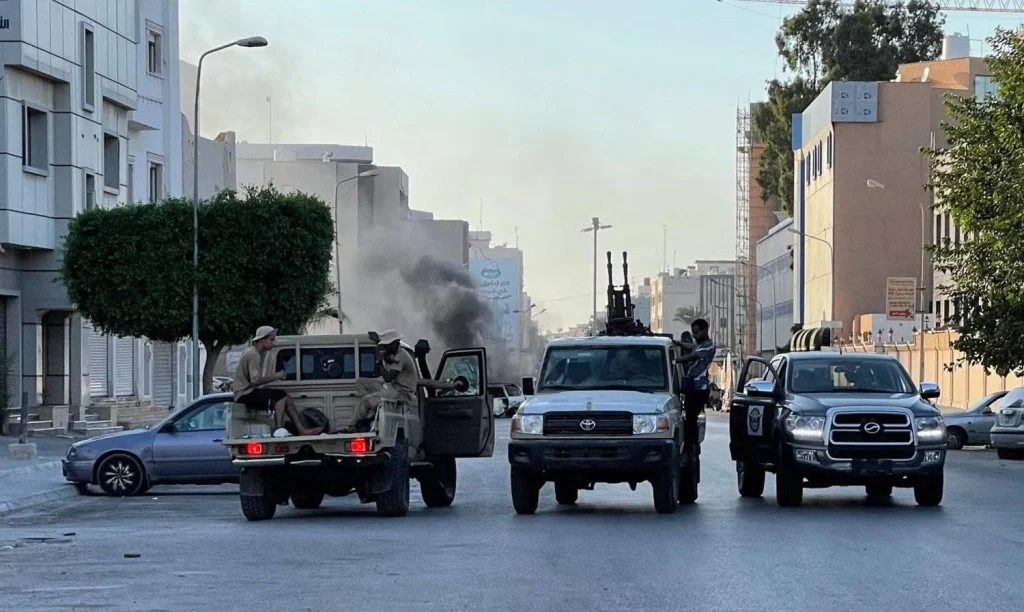
Security forces in Tripoli arrested several suspects linked to recent unrest and attacks on government facilities in the Libyan capital. The arrests followed incidents of vandalism and disturbances targeting state institutions, according to local authorities.
Security units stated that they tracked individuals involved in the unrest and transferred them to judicial authorities for further legal procedures. The operation reflects an ongoing attempt by Tripoli-based institutions to respond quickly to disruptions in public order and assert control over sensitive areas of the capital.
The incident highlights a familiar pattern in Tripoli’s security environment. Authorities can react quickly to unrest, but they still operate within a fragmented security structure that limits long-term stability.
Tripoli continues to face recurring security tensions shaped by overlapping armed formations, political rivalries, and weak institutional consolidation.
Fragmented Security Structures Define Tripoli’s Stability
Tripoli does not operate under a single unified security command. Instead, the capital relies on multiple security actors, including Interior Ministry units, government-aligned armed groups, and former militias integrated into formal structures.
These groups often cooperate on paper, but they maintain different chains of command, loyalties, and financial incentives. This fragmentation shapes how Tripoli responds to unrest.
When incidents occur, security responses depend on coordination between separate units rather than a unified national doctrine. This structure creates gaps in command and delays in response during fast-moving crises.
Over time, this system has produced a form of managed instability. Authorities maintain general control over the capital, but they do not eliminate the conditions that allow unrest to reappear.
Armed groups embedded in the security architecture also maintain territorial influence across neighborhoods, checkpoints, and strategic infrastructure. This influence complicates any attempt to centralize authority.
Unrest in Tripoli Reflects Deeper Political and Institutional Tensions
Security incidents in Tripoli rarely emerge in isolation. They often connect to broader political tensions between competing institutions and factions within Libya’s fragmented governance system.
Government decisions, leadership disputes, or shifts in political alliances often trigger localized unrest. Armed groups also respond to perceived threats to their influence, economic interests, or territorial control.
Many of these groups do not function purely as security actors. They also operate within economic networks tied to state salaries, border control revenues, and protection arrangements for public and private infrastructure.
This overlap between political authority, economic incentives, and armed force creates a volatile environment. It allows tensions to escalate quickly and makes de-escalation dependent on negotiation rather than formal authority alone.
In this context, unrest in Tripoli often reflects competing attempts to redefine influence inside the capital rather than isolated criminal activity.
Containment Strategy Maintains Order but Limits Structural Reform
Tripoli’s security approach relies heavily on containment. Authorities respond to unrest through rapid deployment, targeted arrests, and short-term stabilization measures.
This strategy reduces the risk of prolonged clashes in densely populated areas. It also helps prevent escalation into broader conflict inside the capital.
However, containment does not resolve the structural causes of instability. It manages symptoms rather than addressing underlying fragmentation in the security sector.
Security institutions in Tripoli still depend on negotiated cooperation between competing actors. These arrangements often shift depending on political developments, leadership changes, or financial distributions.
Without long-term security sector reform, Tripoli will likely continue to experience cycles of unrest followed by temporary stabilization. Each cycle reinforces the same structural limitations.
The absence of a unified command structure also limits accountability. Different security actors operate under different chains of authority, which complicates coordination and legal oversight.
As a result, security outcomes depend less on institutional strength and more on balance between competing forces.
Conclusion: Tripoli Stability Depends on Fragile Equilibrium
The latest arrests in Tripoli highlight an ongoing pattern in the capital’s security landscape. Authorities can respond quickly to unrest and restore order in the short term. However, they still operate within a fragmented system that limits long-term stability.
Tripoli’s security environment depends on a fragile equilibrium between competing armed actors and state institutions. This equilibrium prevents total breakdown but also prevents full consolidation.
Until Libya advances meaningful security sector reform and reduces institutional fragmentation, Tripoli will remain vulnerable to recurring cycles of unrest.
The capital does not face a collapse of authority. It faces a structural condition where authority remains divided, negotiated, and constantly contested.