Repeated drone attacks on Zawiyah’s oil complex have pushed one of western Libya’s most volatile cities back into the center of the country’s security crisis.
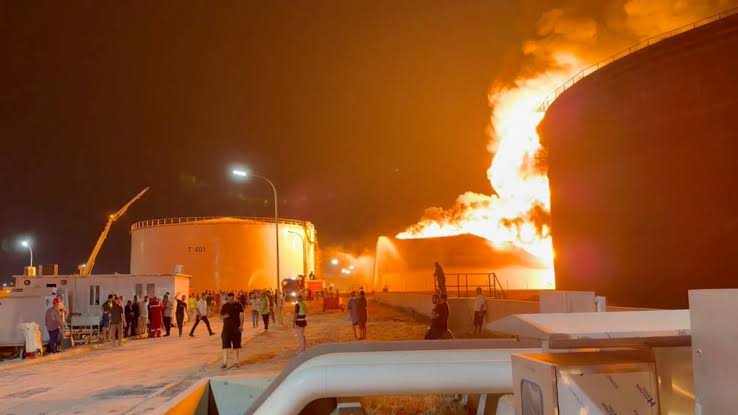
The latest attack struck a fuel storage tank at the Zawiyah refinery on August 10, triggering a major fire. The tank, operated by Brega Petroleum Marketing Company, contained about 4.5 million liters of gasoline before the blaze caused it to collapse. The authorities also reported attacks against other parts of the Zawiyah oil complex and a nearby desalination plant.
The attacks followed a drone strike on an untreated naphtha tank on August 8 and another attack on oil infrastructure over the following days. No group has claimed responsibility. The National Oil Corporation has warned that continued attacks could force it to declare force majeure and halt operations at the refinery.
The immediate security question now goes beyond the protection of the refinery. Reports that the Government of National Unity (GNU) may consider a large-scale military operation in Zawiyah raise a more serious question: can Tripoli impose security on the city without triggering a wider confrontation across western Libya?
Zawiyah Is Not a Local Security Problem
Zawiyah’s violence often appears to outsiders as a collection of rival local armed groups fighting over territory, criminal activity and influence. That description misses the larger picture.
The city sits roughly 40 kilometres west of Tripoli and hosts one of Libya’s most important energy complexes. The 120,000-barrel-per-day refinery connects to the 300,000-bpd Sharara oilfield, while the wider complex includes fuel storage, oil handling and export infrastructure.
That infrastructure gives Zawiyah national importance. Any prolonged disruption can affect fuel supplies, oil operations and the wider western Libyan economy.
The city also occupies a strategic position along the western coastal corridor. Its links to Tunisia and the broader western border region make it important for both legitimate commerce and illicit networks, including fuel trafficking, smuggling and other cross-border activity.
That combination makes control of Zawiyah valuable to actors far beyond the city itself.
The security networks operating there also do not exist in isolation. Armed factions in Zawiyah maintain political, economic and personal relationships with groups elsewhere in western Libya. Some have connections into Tripoli, while others maintain relationships with actors along the coast and toward the Tunisian border.
This creates a major problem for any attempt to impose security through force.
A military campaign might target specific armed groups in Zawiyah, but those groups could draw on external allies and networks. Other factions could also intervene if they believe the operation threatens their own interests.
The result could quickly move beyond Zawiyah.
A Military Campaign Could Spread the Conflict
Libya has already seen how quickly a local confrontation can become a wider security crisis.
The May 2026 fighting in Zawiyah demonstrated the risks. Heavy clashes near the oil complex forced the temporary suspension of refinery operations and prompted warnings from the United Nations Support Mission in Libya over the use of heavy weapons in populated areas. UNSMIL also warned that continued fighting could damage strategic infrastructure and create wider humanitarian and economic consequences.
UNSMIL again warned in late May about armed mobilization and assassination incidents in Zawiyah. It highlighted competition among armed actors for territorial control, influence and access to state resources as a central driver of insecurity.
The latest drone attacks add another layer.
They show that the security environment around the oil complex remains unstable even after earlier efforts to restore order. They also demonstrate how easily armed actors can threaten infrastructure that the Libyan state cannot afford to lose.
A large-scale GNU intervention could therefore produce a paradox.
Tripoli could enter Zawiyah intending to restore state authority, dismantle criminal networks and protect critical infrastructure. But if local factions interpret the operation as an attempt to permanently change the balance of power, they could mobilize outside support.
That would turn a campaign against selected armed groups into a broader contest over western Libya’s security architecture.
The proximity of Tripoli makes this particularly dangerous.
Zawiyah lies close enough to the capital for an escalation there to affect Tripoli directly. Armed groups in the capital could face pressure to support allies, protect their own interests or prevent a precedent in which the GNU uses concentrated military force against a major western Libyan city.
A confrontation in Zawiyah could therefore create pressure for mobilization elsewhere along the coast and inside Tripoli itself.
The Real Test Is State Authority, Not Firepower
The latest attacks have created a genuine security challenge for the GNU. The state cannot allow repeated attacks on oil infrastructure, fuel storage, water facilities and other civilian assets to become normal.
But restoring security requires more than deploying larger numbers of armed men.
The central problem in Zawiyah is the fragmentation of authority. Local armed groups, state institutions, criminal networks and political actors overlap. Some armed formations operate with formal links to state institutions while retaining independent interests and loyalties.
A campaign that ignores those relationships could remove one group while pushing its allies into confrontation.
The GNU therefore faces a difficult choice. It can seek a negotiated security arrangement that gradually reduces the influence of armed groups, or it can attempt to impose control through a major military operation.
The second option carries a much higher escalation risk.
The refinery attacks have already demonstrated the consequences of allowing insecurity to reach critical infrastructure. A wider military confrontation could multiply those consequences by threatening roads, fuel distribution, electricity and water infrastructure while creating new displacement and opening space for further criminal activity.
Zawiyah needs stronger state security. But a campaign designed simply to overwhelm the city could produce the opposite result.
If Tripoli moves against Zawiyah without accounting for the networks that connect the city to the rest of western Libya, the conflict may not remain in Zawiyah for long.
The immediate objective should be to protect civilians and critical infrastructure, identify those behind the attacks and prevent further mobilization.
The larger objective must be to establish state authority without turning Zawiyah into the trigger for another cycle of armed confrontation across western Libya.