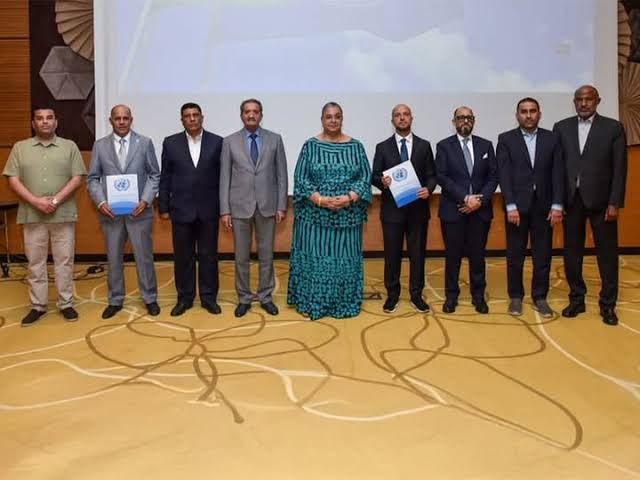
The 4+4 Committee has signed a joint agreement under United Nations auspices that seeks to create a new path toward national elections and end Libya’s prolonged political division. The agreement marks the first major joint understanding between representatives of the country’s eastern and western power centers through this format in five years.
The committee brings together eight representatives from four institutions that hold significant influence over Libya’s political and military landscape. The western side includes representatives of the Government of National Unity and the High State Council, while the eastern side includes representatives of the House of Representatives and the General Command led by Khalifa Haftar.
The agreement does not itself deliver elections. Instead, it establishes a framework for resolving several disputes that blocked the December 2021 electoral election and have since prevented Libya from reaching a national political settlement.
A New Political Path
The committee recommends amendments to the electoral laws, restructuring the board of the High National Elections Commission, and appointing a new president for the commission. It also recommends holding presidential and parliamentary elections within 24 months under a single executive authority and unified state institutions.
That last point carries particular political weight. Libya currently operates through divided institutions and competing centers of authority, making any transition toward a single executive structure politically difficult.
The agreement therefore attempts to address both the electoral process and the institutional divisions that have repeatedly prevented Libya from reaching elections.
The Military Question
One of the agreement’s most consequential elements concerns the participation of military personnel in elections. The proposed electoral framework would allow members of the military to vote and stand as candidates.
That provision could significantly affect Libya’s political-security balance. Libya’s armed groups and military institutions hold considerable political influence, particularly in the east, while the country continues to operate without a unified military establishment.
Allowing military personnel to enter the electoral process could create a new channel between Libya’s security institutions and formal politics. It could also generate disputes over military neutrality, eligibility requirements and the relationship between elected institutions and commanders.
The issue becomes particularly sensitive because Libya’s political divide also reflects a deeper division between competing security structures. Any electoral law that gives military personnel a formal political role will need clear rules that prevent political competition from further fragmenting the security sector.
The Real Test
The agreement still faces an important institutional test. The House of Representatives and the High State Council must approve it within one month before the proposed framework can move forward.
That requirement gives both institutions an opportunity to challenge, amend or delay the agreement. Previous Libyan political agreements have repeatedly shown that signing a framework does not guarantee implementation.
The committee has reportedly outlined another route if the two institutions fail to ratify the agreement. The parties could pursue a broader national mechanism and seek support from the UN Security Council, potentially placing the agreement within the wider UN-led political process in Libya.
That fallback could shift the process away from the two institutions that have repeatedly disagreed over Libya’s political transition. However, it could also trigger another dispute over legitimacy and authority.
The agreement therefore represents an important political opening, but it does not resolve Libya’s core institutional divisions. The next stage will determine whether the 4+4 format can translate consensus among influential actors into decisions that Libya’s competing institutions will actually accept.
For Libya’s security landscape, the military participation provision deserves particular attention. If Libya adopts electoral rules that allow military personnel to compete for political office, the country could see a major change in how military power interacts with the political system.
The agreement creates a potential roadmap toward elections, implementation, however, remains the real test.