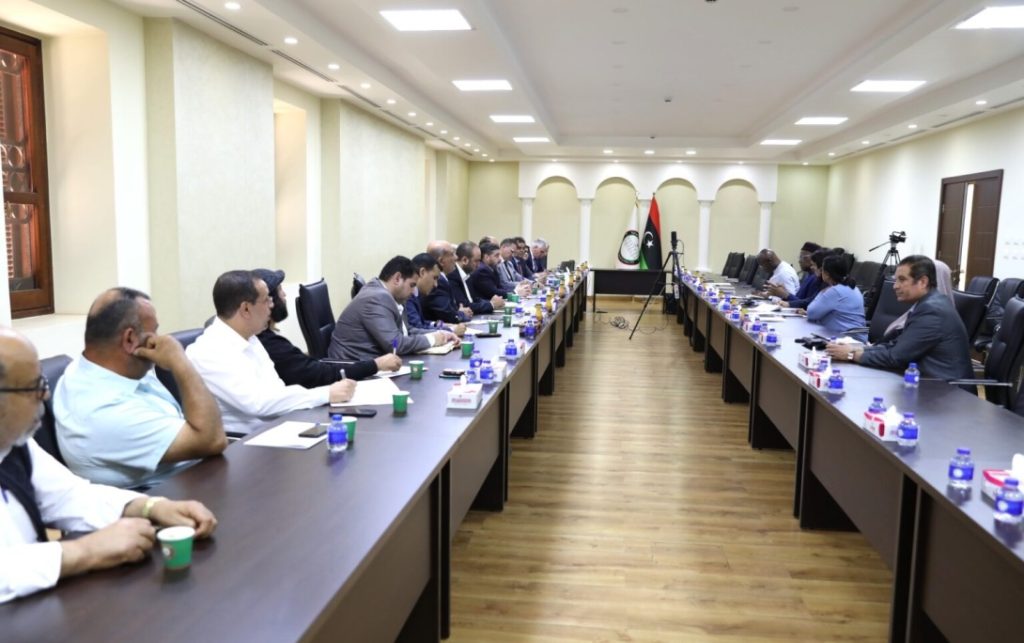
Mayors from nine key Libyan cities met in Misrata this week and announced the formation of a new “Central Libya Region.” The proposal would expand Libya’s administrative structure from three regions into four, adding a central bloc that covers major coastal and inland cities.
The announcement includes Misrata, Zliten, Al-Khums, Bani Walid, Tarhuna, Masallata, Qasr Al-Akhyar, Tinina, and Al-Mardoum. The group framed the initiative as a step toward stronger local governance and better coordination between municipalities that share economic and geographic ties.
But the timing and structure of the announcement raise bigger questions. Libya does not lack administrative labels. It lacks unified authority over them. This move therefore sits at the intersection of governance reform, political signaling, and long-term institutional fragmentation.
The key question is not whether a “Central Region” makes administrative sense. The question is whether Libya’s local actors now begin to shape national structure from the bottom up.
A Municipal Initiative with National Implications
The proposal did not come from Libya’s central institutions. It did not come from the House of Representatives, the Government of National Unity, or any formal constitutional process.
It came from mayors. That detail matters.
Libyan municipalities already carry significant weight in daily governance. They manage services, mediate local disputes, and often operate in environments where national coordination remains weak. Over time, municipalities have become de facto power centers, especially in areas where state institutions struggle to enforce consistent authority.
The Misrata meeting highlights this reality. Local leaders did not wait for national consensus. They acted as a coordinated bloc and presented a regional framework that reflects their own political and economic geography.
This does not yet create a new region in legal terms. But it does signal how governance in Libya continues to evolve outside formal state channels.
Misrata and the Geography of Influence
Misrata sits at the center of this announcement, and that placement is not accidental.
The city holds a unique position in Libya’s political landscape. It combines economic strength, military influence, and institutional capacity that surpasses many other municipalities. It also maintains strong networks across western and central Libya, giving it a bridging role between coastal and inland areas.
By hosting and anchoring the “Central Region” initiative, Misrata effectively shapes the emerging map of influence. The other participating cities reflect a natural economic corridor and shared logistical space that links ports, trade routes, and agricultural zones.
On paper, the initiative promotes coordination. In practice, it also reflects the consolidation of a regional bloc that already exists informally.
Libya rarely separates administrative geography from political influence. The two overlap constantly. Any structured grouping of cities therefore carries both governance meaning and political weight.
Libya’s De Facto Regional Fragmentation
Libya already operates as a fragmented system, even without formal recognition of that structure.
The east maintains its own political and military institutions. The south functions under security-heavy arrangements shaped by border dynamics and resource scarcity. The west splits into multiple centers of influence, where municipalities, armed groups, and national institutions overlap.
In this environment, the idea of three unified regions already stretches reality. Local governance often responds to practical conditions rather than national frameworks.
The “Central Region” proposal does not create fragmentation. It reflects it.
It also formalizes a pattern that has grown over years: local actors organizing around regional needs instead of national systems.
This raises an important shift. Libya no longer debates centralization versus decentralization in abstract terms. It now experiences decentralization through practice, not policy.
The Political Risk of Informal Regionalization
The creation of a new regional identity carries both administrative and political consequences.
On the administrative side, proponents argue that a central coordination framework can improve service delivery, align municipal planning, and strengthen local cooperation. Libya’s infrastructure challenges and uneven governance structures make coordination across municipalities a practical necessity.
But the political implications run deeper.
Once municipalities begin to organize into regional blocs, they also begin to negotiate collectively. That changes how they interact with national institutions. It can shift budget discussions, influence development priorities, and reshape political alliances.
In fragile political systems, administrative groupings rarely stay purely technical. They evolve into negotiation platforms.
Libya has already seen similar dynamics before. Temporary coordination bodies and regional alignments have often moved beyond service delivery into political representation. The risk lies not in the formation of the group itself, but in how quickly it gains informal authority.
If central institutions remain weak or divided, regional blocs can fill that vacuum.
What This Means for Libya’s Future Governance Map
The “Central Libya Region” announcement does not change Libya’s legal structure. No constitutional amendment supports it. No national institution has endorsed it.
But it still matters. It shows that Libya’s governance map continues to shift away from formal hierarchy and toward functional geography. Cities that share trade routes, infrastructure networks, and security concerns increasingly coordinate directly with each other.
That trend can improve efficiency in the short term. It can also complicate national integration in the long term.
The next stage will depend on how Libya’s central institutions respond. If they engage with the initiative and define clear legal frameworks, the concept may evolve into structured decentralization. If they ignore it, the regional model may grow independently and deepen fragmentation.
The difference between those two paths is significant.
One leads to managed decentralization within a unified state. The other leads to parallel governance structures that slowly harden over time.
Conclusion: A New Layer, Not a New System, Yet
The announcement of a “Central Libya Region” does not represent a finished political reform. It represents an emerging layer of organization within an already fragmented system.
Libya’s political reality continues to evolve through local action rather than national design. Municipal leaders now shape coordination frameworks that reflect lived geography more than formal state planning.
Whether this development becomes a tool for better governance or a step toward deeper fragmentation depends on what comes next.
For now, the central region exists as an idea backed by municipalities, not institutions. But in Libya’s current environment, ideas backed by coordinated local actors often become the starting point for real structural change.