How a reported military arrangement with Tripoli, a network of strategic facilities and attacks on Russian maritime assets are bringing the Russia–Ukraine conflict closer to the central Mediterranean.
Western Libya is emerging as an increasingly important part of the wider confrontation between Ukraine and Russia. A series of investigative reports published earlier this year has identified a previously undisclosed Ukrainian military presence in the country, including personnel reportedly operating from three locations around Misrata, Zawiya and Tripoli.
The revelations have acquired greater significance following attacks on Russian-linked maritime assets in the Mediterranean, including the March 2026 strike on the Russian liquefied natural gas carrier Arctic Metagaz and the Ukrainian drone attack on a Russian naval vessel in Benghazi on 22 November.
Although the precise extent of Ukraine’s activities in Libya remains difficult to establish independently, the available reporting points to the emergence of a potentially significant operational relationship between Kyiv and the Tripoli-based authorities.
A reported military agreement with Tripoli
The most detailed account of Ukraine’s presence in western Libya emerged through an investigation by Radio France Internationale (RFI), published back in April. Citing two Libyan sources who spoke anonymously, RFI reported that more than 200 Ukrainian military officers and specialists had been deployed in western Libya with the agreement of the government led by Prime Minister Abdulhamid Dbeibah.
According to the investigation, the deployment followed an agreement reportedly concluded in October 2025. The arrangement was said to involve Ukrainian assistance with drone training for Libyan forces, alongside prospective arms deliveries and investment in Libya’s oil sector. In return, Kyiv would be permitted to establish a military presence in the country.
These details were subsequently reported by the Kyiv Independent, which noted that neither the Ukrainian nor Libyan authorities had publicly confirmed the agreement. The publication also said it had been unable to independently verify RFI’s reporting.
The reported October 2025 agreement is therefore an important element of the story, but it should not be treated as a publicly authenticated bilateral military document.
Three locations, three reported functions
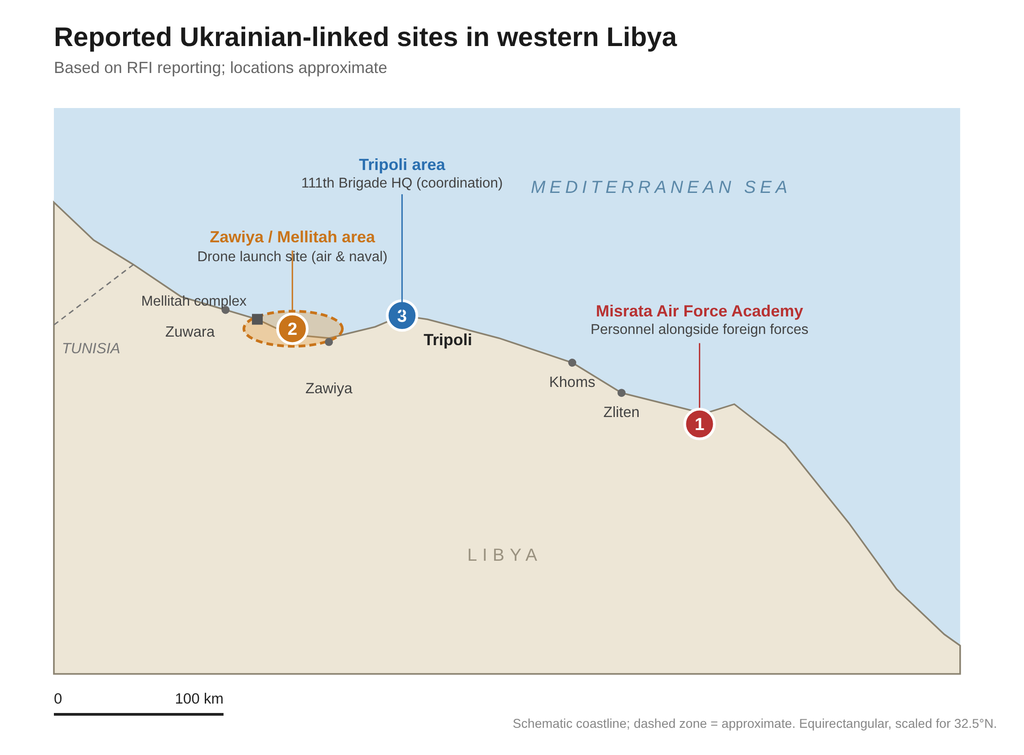
RFI identified three locations in western Libya associated with the Ukrainian deployment, each reportedly serving a different purpose.
The first is the Air Force Academy in Misrata, where Ukrainian personnel are said to be based alongside foreign military personnel, including Turkish and Italian forces. RFI also reported the presence of US Africa Command (AFRICOM) personnel and a British intelligence centre at the facility. Misrata is therefore identified as an important centre of the reported Ukrainian presence, although the reporting does not establish that all personnel at the installation operate within a single command structure.
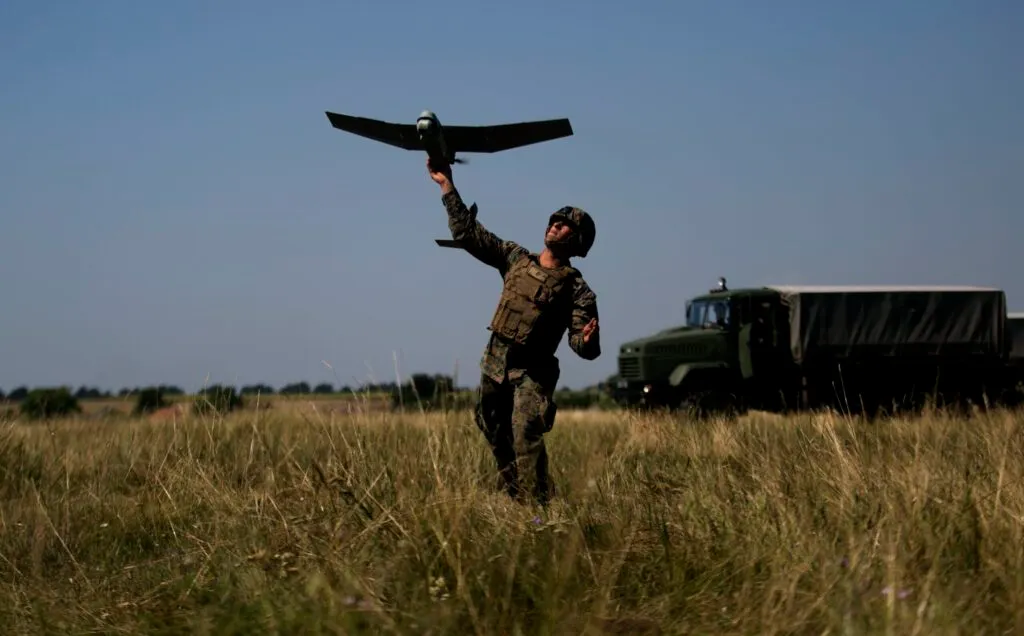
The second location is in Zawiya, near the Mellitah Oil and Gas Complex. According to RFI’s Libyan sources, Ukrainian personnel have access to a facility equipped for launching aerial and naval drones. The sources described the site as occupying land allocated by the Tripoli government, with direct access to the sea. Its reported location is strategically significant given the proximity of the Mediterranean shipping lanes and Libya’s energy infrastructure.
The third location is the headquarters of Libya’s 111th Brigade, a formation affiliated with the Tripoli government’s Ministry of Defence. RFI reported that the facility is used for coordination meetings between Ukrainian personnel and Libyan military representatives.
These accounts suggest a presence extending beyond a conventional military advisory mission. However, the available reporting does not independently establish the precise command arrangements, staffing levels or permanent operational capabilities at each location.
The three-site account was also reproduced by Agenzia Nova and Euronews, both of which explicitly attributed the underlying findings to RFI.
From the Mediterranean to Benghazi
The significance of the reported deployment became more apparent following the attack on the Russian-flagged LNG carrier Arctic Metagaz in March 2026.
The vessel was damaged by explosions and fire in the Mediterranean on 3–4 March. It was carrying liquefied natural gas and was associated with Russia’s so-called shadow fleet, a network of vessels used to transport Russian energy exports through opaque ownership structures and shipping arrangements.
RFI subsequently reported that Ukrainian forces were responsible for the attack, allegedly using a Magura V5 unmanned surface vessel launched from the reported facility near Mellitah.
This attribution was based on RFI’s Libyan sources. It should not be confused with a publicly released operational record independently establishing the drone’s launch point. Euronews’ coverage of the investigation also noted that Ukrainian authorities had not publicly confirmed responsibility for the attack.
The story took a more consequential turn on Sunday, when a Russian naval corvette, the Merkury, was struck at Benghazi’s naval base in eastern Libya.
Ukrainian President Volodymyr Zelenskyy publicly acknowledged the operation yesterday. He said Ukrainian forces had targeted the Russian corvette and the cargo vessel MV Angara, which he described as being involved in transporting military equipment.
The Ukrainian Security Service (SBU) subsequently released footage of the operation showing Ukrainian Sea Baby maritime drones attacking the Russian vessels. The SBU described the operation as a strike against Russian military logistics.
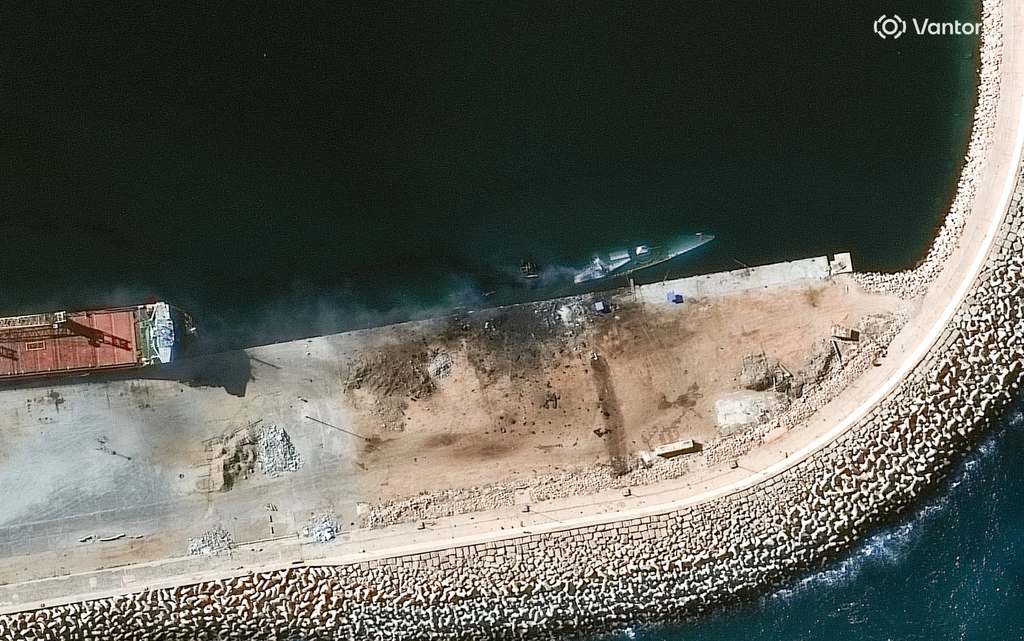
The AP also reported that the corvette suffered severe damage and that a Ukrainian operation had been conducted from western Libya, where Ukrainian drone specialists had reportedly operated for approximately a year under an arrangement with the Tripoli-based government.
However, the precise launch arrangements require qualification. Libyan military officials had previously told the AP that an initial investigation indicated Ukrainian naval drones were launched from a western Libyan base. That account was attributed to officials speaking anonymously, rather than to independently published evidence establishing the drones’ point of departure.
The November operation nevertheless represents a significant development: Ukrainian maritime drones have now been publicly associated with an attack on Russian naval assets inside a Libyan port, extending the geographical reach of the conflict into the central Mediterranean.
Turkey’s role and the wider geopolitical picture
Turkey’s involvement is an important part of the strategic context, but its relationship with Ukraine’s reported deployment requires careful treatment.
An established Turkish military presence in western Libya predates the reported Ukrainian arrangement. The UN Panel of Experts’ December 2024 report documented Turkish military training activities in Misrata and Tripoli, including training provided to forces affiliated with the Tripoli government during 2023 and 2024.
The report also documented the legal framework for Turkish-Libyan military cooperation, including agreements signed in 2012 and 2019.
Importantly, the UN report identified a Turkish Bayraktar Akıncı unmanned combat aerial vehicle at Misrata airbase in March 2024, supported by satellite imagery. This provides further evidence of Turkey’s established military infrastructure and capabilities in western Libya.
It does not, however, establish that Ankara negotiated, authorized or exercises operational control over Ukraine’s reported deployment.
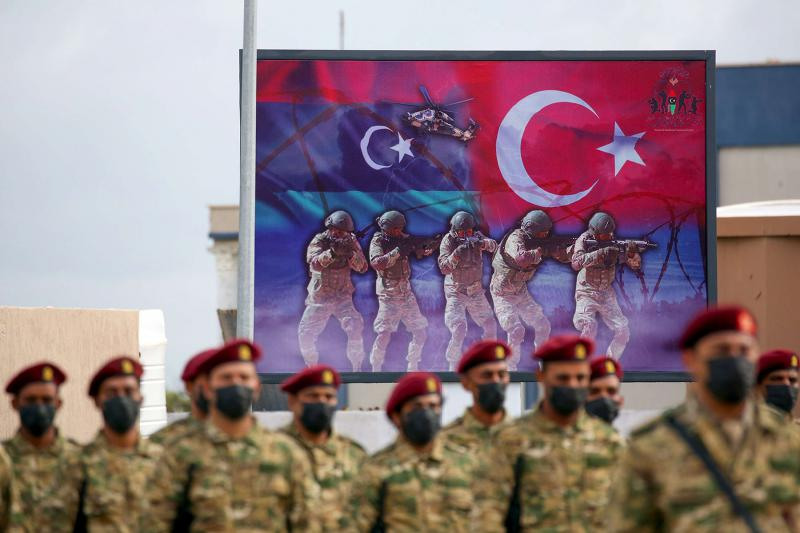
The distinction is particularly important because Libya remains politically and militarily divided. The Tripoli-based administration maintains close relations with Turkey and Western governments, while eastern Libya’s military leadership under Khalifa Haftar has cultivated relations with Moscow.
The November attack on the Merkury illustrates the potential consequences of these competing relationships. The vessel was docked at Benghazi under a cooperation arrangement with the eastern authorities, while the reported Ukrainian operational network is located in territory controlled by the rival Tripoli administration.
In effect, Libya’s existing political divisions provide the setting for an increasingly direct confrontation between the interests of Moscow and Kyiv.
An emerging Mediterranean theatre
Ukraine’s reported presence in western Libya represents a potentially significant geographical expansion of its military activities. The country’s coastline offers access to major Mediterranean shipping routes and places Russian maritime movements within reach of Ukrainian unmanned systems operating far beyond the Black Sea.
The attacks on the Arctic Metagaz and Merkury demonstrate the growing importance of maritime drones in Ukraine’s campaign against Russian military and economic assets. They also highlight the risks of extending the conflict into a country already struggling with competing governments, foreign military deployments and fragmented security institutions.
Nevertheless, several important questions remain unanswered. The full terms of the reported October 2025 agreement have not been publicly established. The figure of more than 200 Ukrainian personnel originates from anonymous Libyan sources, and the precise responsibilities of each reported facility remain unclear. Nor has the extent of Turkish or Western involvement in the Ukrainian deployment been independently documented.
What is increasingly difficult to dismiss, however, is the significance of the reported Ukrainian military presence in western Libya and its connection to the widening confrontation over Russian maritime assets.
For Libya, the danger is that its territory and infrastructure could become increasingly entangled in a conflict that began thousands of kilometres away. For Ukraine, western Libya may offer an additional strategic position from which to challenge Russian interests in the Mediterranean and across Africa.
The extent to which that presence develops into a sustained operational arrangement will depend on political decisions in Tripoli, the response of eastern Libyan authorities and the willingness of foreign partners to tolerate further expansion of the conflict.