Repeated drone attacks on Zawiyah’s oil and energy infrastructure have turned a local security problem into a broader threat to western Libya’s critical infrastructure. The attacks have damaged fuel storage tanks, threatened refinery operations and, most recently, struck an electricity substation that supplies large areas south of the city.
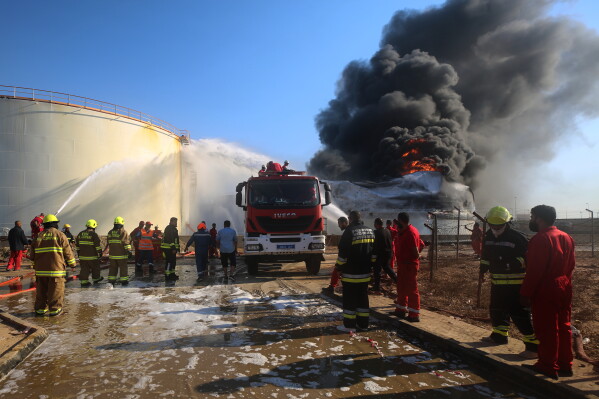
The National Oil Corporation (NOC) brought the latest fires at the Zawiyah oil complex under control after several days of attacks. But the immediate damage tells only part of the story. The more important security question is who can repeatedly penetrate the city’s airspace, select high-value targets and strike them without publicly claiming responsibility.
So far, no group has claimed the attacks. That makes attribution difficult. It also raises a more serious concern: the attacks may reflect the emergence of a relatively low-cost method for coercing the Libyan state without the need for a large ground force.
The Fires Began With Targeted Strikes
The sequence of attacks matters. On August 8, a drone struck a tank containing untreated naphtha at the Zawiyah refinery. The impact punched holes into the tank and caused a leak, but the incident did not initially produce a fire. Refinery personnel managed to contain the leak.
The situation escalated over the following days.
On August 10, another drone attack struck fuel storage infrastructure inside the Zawiyah oil complex. One gasoline tank containing about 4.5 million litres caught fire and later collapsed. Other attacks hit additional parts of the complex, while another drone fell near critical infrastructure.
This distinction is important. The major fires did not appear spontaneously because of an existing refinery malfunction. They followed direct attacks on fuel-storage infrastructure.
The refinery itself suffered disruption, but engineers said the main refinery remained intact. That suggests the attackers did not simply seek to destroy the entire processing facility. Instead, they repeatedly targeted vulnerable parts of the wider complex, particularly storage and associated infrastructure.
That targeting pattern raises the possibility of a deliberate strategy.
Fuel tanks offer an attacker an attractive combination of visibility and disruption. A successful strike can create a major fire, force emergency shutdowns, threaten nearby infrastructure and generate political pressure without necessarily destroying the refinery itself.
The psychological effect also matters. A burning fuel tank inside one of Libya’s most important energy facilities sends a much larger message than damage to an isolated building.
The Target Set Is Now Expanding
The attacks no longer appear limited to the refinery.
On August 12, Libya’s General Electricity Company reported an attack on the South Zawiya substation that caused a complete outage across wide areas south of the city.
That development significantly changes the security picture.
If the refinery attacks and the substation strike form part of the same campaign, the objective may extend beyond disrupting oil production. The attackers would then be demonstrating an ability to threaten several components of Zawiyah’s critical infrastructure network.
Oil, fuel storage and electricity are interconnected. Damage to one can increase pressure on the others.
A refinery depends on electricity. Fuel distribution depends on functioning roads, pumping systems and communications. Emergency response depends on power and access. A coordinated campaign against several nodes could therefore create disruption disproportionate to the physical damage caused by each individual strike.
This also creates a difficult problem for the Libyan authorities. Protecting one facility does not necessarily protect the city. If attackers can shift between oil tanks, pipelines, power infrastructure and other strategic sites, security forces must protect a much larger area.
Who Is Flying the Drones?
This remains the biggest unanswered question. No group has publicly claimed responsibility for the attacks, and Libyan authorities have not publicly provided conclusive evidence identifying the perpetrators. Prime Minister Abdulhamid Dbeibah has described the strikes as serious organized crimes, but that is not the same as establishing who planned and carried them out.
The absence of attribution creates several possible explanations.
One possibility involves armed groups or criminal networks operating in and around Zawiyah. The city has long faced competition among armed actors over territory, smuggling routes, economic resources and political influence. The refinery sits inside this contested environment.
Another possibility involves political actors seeking to pressure rivals without openly entering a new armed confrontation. Drones offer an unusual advantage in this environment. They can create disruption while reducing the visibility and immediate cost associated with deploying fighters.
A third possibility involves outside assistance. Armed actors in Libya have previously benefited from foreign military support, equipment and expertise. However, there is currently no public evidence that a foreign state directed these specific attacks.
That distinction matters. The availability of drones does not by itself prove foreign involvement.
Libya has seen widespread access to relatively inexpensive unmanned systems, and the technology no longer belongs exclusively to conventional militaries. The critical question is not simply who owns the drones. It is who possesses the intelligence, access and operational capability needed to repeatedly select sensitive targets.
The attackers have demonstrated at least some knowledge of the physical layout of the Zawiyah complex. Whether that knowledge came from local observation, previous access to the facility or publicly available information remains unclear.
Why Zawiyah Is Particularly Vulnerable
Zawiyah presents an unusually attractive target because of the concentration of strategic infrastructure around the city.
The refinery has a capacity of around 120,000 barrels per day and connects to the 300,000-barrel-per-day Sharara oilfield. The wider complex also contains fuel storage and oil-handling infrastructure.
The city also sits only about 40 kilometres west of Tripoli and occupies a key position along western Libya’s coastal corridor. Its location gives it importance for trade, fuel distribution and cross-border networks.
That concentration creates a security dilemma.
Protecting a refinery does not mean protecting every fuel tank around it. Protecting the oil complex does not protect the electricity network. And securing the city center does not necessarily prevent an unmanned aircraft from reaching a strategic facility.
The recent attacks expose that gap between territorial security and infrastructure security.
Libyan authorities may control checkpoints, deploy armed units and maintain security formations around major sites while still struggling to defend those sites against a small aerial threat.
That is a fundamentally different security problem from the street fighting that has traditionally defined Zawiyah’s instability.
The Drone Threat Could Change Western Libya’s Security Calculus
The most important implication may be the precedent.
Drones allow relatively small actors to threaten assets that would otherwise require significant manpower and firepower to attack. They can also create uncertainty over attribution, making retaliation more difficult.
That could encourage a new form of coercion in western Libya.
Instead of fighting for control of a facility, an armed actor can threaten the facility. Instead of occupying infrastructure, it can make the infrastructure unsafe to operate.
The NOC has already warned that continued attacks could force it to halt operations at the Zawiyah refinery and consider force majeure.
That creates leverage.
An attacker does not necessarily need to destroy the refinery to achieve a strategic effect. If repeated strikes force workers to leave, insurance costs to rise, shipments to change and operators to suspend activity, the economic consequences can accumulate without a conventional assault.
The risk extends beyond oil.
The August 12 attack on the South Zawiya substation shows how the same vulnerability can affect electricity supply. If attacks continue against power, fuel, water or transport infrastructure, Zawiyah could face a cascading infrastructure crisis.
That would also increase pressure on Tripoli.
A New Test for State Authority
The drone campaign exposes a deeper weakness in Libya’s security system: the state does not yet possess a unified mechanism for protecting critical infrastructure across western Libya.
The previous security crisis in Zawiyah centered on armed groups, territorial control and the possibility of a major GNU military operation. The drone attacks create a different challenge.
The state can deploy forces into the city, but those forces cannot easily guarantee that critical infrastructure remains safe from an aerial threat.
This creates a dangerous cycle. A major military operation could increase tensions with local armed groups, while a limited security response could fail to stop further attacks.
The government therefore faces a problem that cannot be solved through firepower alone.
It needs intelligence on who operates the drones, how they reach their targets and what networks support the attacks. It also needs stronger surveillance and protection around critical infrastructure, alongside a clearer chain of command between civilian operators and security forces.
Most importantly, investigators need to establish attribution before the government takes military action against a suspected perpetrator.
A mistaken attribution could turn an infrastructure security crisis into a much wider armed confrontation.
For now, the central mystery remains unresolved: who is flying the drones over Zawiyah?
But the attacks have already demonstrated something almost as important.
The threat is no longer confined to armed men fighting for control of the city. An unidentified actor can now reach some of Libya’s most important oil and energy assets from the air, ignite millions of litres of fuel and disrupt electricity supplies without publicly declaring who it represents.
That changes the security equation in western Libya.
Zawiyah’s latest crisis is therefore not simply another episode of local violence. It is a warning that Libya’s fragmented security environment has acquired a new tool, and that critical infrastructure may be among its easiest targets.