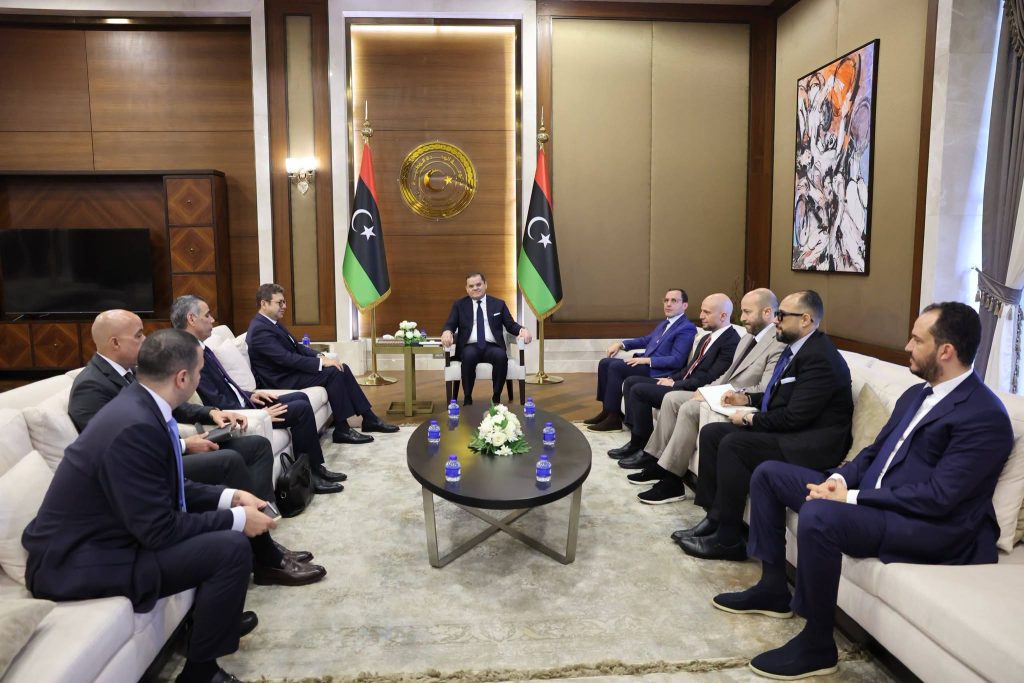
Libyan Prime Minister Abdul Hamid Dbeibeh met Egyptian General Intelligence Chief Hassan Rashad and his delegation in Tripoli to review security coordination, border stability, and regional developments. The meeting reflects deeper intelligence engagement between Libya and Egypt at a time of persistent instability along Libya’s borders and rising security risks across the Sahel and North Africa.
The talks highlight how security institutions now drive much of the Libya–Egypt relationship. Political dialogue continues, but intelligence cooperation increasingly defines practical coordination on the ground. Both sides now prioritize border control, counterterrorism, and regional risk management as core pillars of engagement.
Intelligence coordination and border security shape discussions
Both delegations focused on strengthening intelligence cooperation and expanding coordination between security institutions. They reviewed border security challenges along the Libya–Egypt frontier and discussed mechanisms to improve information sharing between agencies. The talks also addressed counterterrorism cooperation and the monitoring of cross-border movements linked to armed groups and criminal networks.
The Libya–Egypt border remains one of the most sensitive security zones in North Africa. The frontier stretches across vast desert terrain that limits consistent state control in several areas. Smuggling networks continue to operate along remote corridors, and armed groups move intermittently through poorly monitored routes. Weapons trafficking also remains a long-standing concern tied to Libya’s internal fragmentation.
Egypt treats this border as a direct national security priority. Cairo views instability in eastern and southern Libya as a potential entry point for militant activity and illicit trade. Libya, in turn, relies on Egyptian cooperation to help manage broader regional risks that extend beyond its administrative capacity. Both sides now treat intelligence sharing as a necessary tool to reduce escalation risks.
Political developments and regional alignment
The meeting also reviewed Libya’s internal political situation and ongoing efforts to stabilize state institutions. Discussions covered the current political deadlock, continued fragmentation between rival administrations in the east and west, and the absence of a unified institutional framework. Both sides acknowledged that Libya’s political transition remains stalled and that institutional division continues to undermine security coordination.
Egypt reiterated its interest in supporting stability efforts in Libya. Cairo consistently positions itself as a regional stakeholder in Libya’s political trajectory due to direct security and border implications. Egyptian officials reaffirmed support for Libya’s unity, sovereignty, and territorial integrity during the meeting.
Cairo’s approach reflects a broader strategy that links Libya’s internal stability with Egypt’s national security. Egyptian policymakers consistently view Libya not only as a neighboring state but also as a strategic buffer zone. Any instability in Libya’s western and southern regions increases pressure on Egypt’s border security architecture and counterterrorism planning.
Libyan officials also emphasized the importance of maintaining open channels with regional partners. Tripoli continues to seek external support to stabilize institutions and manage security risks that exceed domestic capacity. The meeting reinforced the idea that Libya’s political fragmentation continues to shape its external security relationships.
Intelligence diplomacy gains weight in Libya crisis management
The Tripoli meeting highlights the growing importance of intelligence diplomacy in Libya’s crisis environment. Security agencies now play a central role in maintaining coordination between Libya and regional actors, particularly on sensitive issues that formal political channels struggle to resolve.
Intelligence-level engagement allows both sides to bypass political stalemates and focus on operational security priorities. These include border monitoring, counterterrorism coordination, and the disruption of smuggling networks. Security institutions often maintain continuity even when political frameworks remain divided or incomplete.
This form of diplomacy also supports communication between fragmented Libyan institutions. Libya’s divided political structure limits unified decision-making, especially on security policy. Intelligence coordination therefore provides a more stable channel for cooperation, particularly in areas where immediate operational decisions matter more than long-term political agreements.
The Libya–Egypt relationship reflects this broader trend. Both countries now rely on intelligence communication as a practical mechanism to manage shared risks. This approach has become more relevant as regional instability increases and traditional diplomatic processes struggle to keep pace with security developments.
Regional instability across the Sahel increases pressure
The meeting took place against a backdrop of rising instability across the Sahel region. Armed groups continue to expand operations across porous borders, and security conditions in several neighboring states remain fragile. These dynamics increase pressure on Libya’s southern frontier and indirectly affect Egypt’s western security perimeter.
Weapons flows from Libya’s conflict zones continue to move across regional networks. Southern Libya remains a key transit area for illicit trafficking routes that connect North Africa with the Sahel. Weak enforcement capacity in remote desert areas allows armed groups and criminal networks to exploit gaps in state control.
Instability in Sudan and other Sahel countries further complicates the regional security environment. These crises increase cross-border movement risks and expand the operational space for armed groups. Egypt closely monitors these developments due to their potential impact on its border security strategy.
Libya also faces internal constraints that limit its ability to fully secure its southern regions. Fragmented institutions and competing security structures reduce coordination effectiveness in remote areas. This gap increases reliance on regional partners, particularly Egypt, to manage shared security risks.
Egypt’s strategic role in Libya’s security landscape
Egypt continues to position itself as a key regional actor in Libya’s security architecture. Cairo maintains consistent engagement with multiple Libyan stakeholders and prioritizes stability over factional alignment. This approach allows Egypt to maintain influence across Libya’s divided political landscape while focusing on long-term security outcomes.
The meeting with the intelligence chief reflects this strategy. Egypt uses intelligence channels to maintain continuity in its Libya policy, even as political conditions shift. This method enables Cairo to respond quickly to emerging security threats without relying solely on formal diplomatic processes.
For Libya, Egyptian engagement provides operational support in managing border security and regional coordination. Libya’s fragmented security environment makes external cooperation essential for monitoring large-scale threats such as smuggling networks and cross-border militancy. Egypt’s established intelligence infrastructure adds capacity to these efforts.
Both countries now view their relationship through a security-first lens. Political differences remain secondary to shared concerns about stability, border integrity, and regional spillover risks.
Analytical outlook
The Tripoli meeting signals a continued shift toward intelligence-driven coordination between Libya and Egypt. Both sides now prioritize security cooperation as the foundation of their bilateral relationship, particularly in response to instability across the Sahel and Libya’s ongoing political fragmentation.
This trend will likely continue as regional pressure increases. Border security challenges, armed group mobility, and regional instability all reinforce the need for sustained intelligence collaboration. Libya’s divided institutions and Egypt’s security priorities converge on this point, even when political processes remain stalled.
Intelligence diplomacy will likely remain one of the most stable and effective channels for Libya–Egypt engagement. As long as Libya’s political transition remains unresolved and regional instability persists, both countries will continue to rely on security coordination as their primary mechanism for managing shared risks.