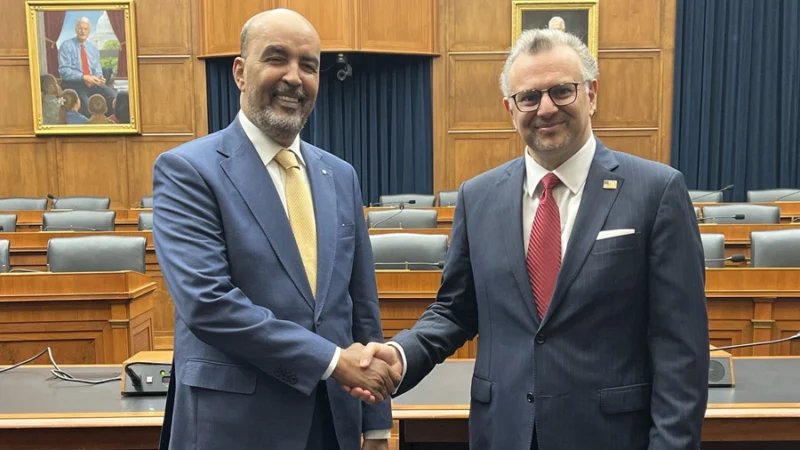
A high-level conference in Washington, D.C. on April 24, 2026 has sharpened focus on Libya’s political future. Officials from both countries called for a realistic roadmap toward elections, stronger institutional unity, and deeper security coordination.
The event, hosted by the National Council on U.S.-Libya Relations, brought together policymakers, analysts, and senior Libyan figures. Participants examined Libya’s political trajectory at a time of renewed diplomatic engagement and fragile internal balance.
Among the key speakers, Musa Al-Koni delivered a direct message. He said any political process must rest on national consensus and practical implementation. He rejected abstract proposals that lack enforcement mechanisms.
Al-Koni urged Libyan institutions to move beyond rivalry and focus on execution. He warned that competing political frameworks without coordination will deepen fragmentation. He also stressed that Libya cannot afford another stalled transition.
On the U.S. side, Massad Boulos outlined Washington’s priorities. He confirmed continued U.S. support for a unified Libyan state and a credible electoral process. He framed stability as a product of aligned political, security, and economic tracks.
The conference marked a shift toward practical outcomes. Participants focused less on theoretical agreements and more on enforceable steps.
Institutional unity and elections dominate policy agenda
Speakers placed institutional unity at the center of Libya’s recovery strategy. They argued that divided governance structures continue to block progress.
Al-Koni called for coordination between the House of Representatives and the High Council of State. He said both bodies must agree on a unified political framework. He linked that agreement directly to the success of future elections.
Boulos reinforced that position. He said elections cannot succeed without unified institutions. He pointed to fragmentation in executive and legislative bodies as a core obstacle.
U.S. officials also highlighted growing cooperation between eastern and western actors. They described recent engagement as a positive signal. However, they warned that informal coordination does not replace formal unification.
Participants stressed that Libya needs a single executive authority with nationwide legitimacy. Without that, electoral outcomes may face immediate dispute.
The discussion also addressed electoral feasibility. Speakers acknowledged that Libya has announced election timelines before. Those plans failed due to legal disputes and security tensions. This time, they pushed for a process built on enforceable agreements.
Al-Koni emphasized inclusivity. He said all regions must participate in shaping the political roadmap. He warned that exclusion will undermine any agreement before implementation begins.
That message carried strong implications for southern Libya.
Security coordination and regional inclusion remain critical challenges
Security coordination emerged as a second core theme. Participants agreed that political progress depends on stability on the ground.
Boulos identified unified military structures as a top priority. He said fragmented security forces create space for conflict and weaken state authority. He called for structured coordination between rival factions.
Speakers discussed ongoing efforts to align military leadership. They described these efforts as fragile but necessary. They also noted that trust remains limited between key actors.
Al-Koni linked security reform to political legitimacy. He argued that citizens will not trust elections without security guarantees. He called for a national framework that ensures protection across all regions.
Regional imbalance drew particular attention. Al-Koni highlighted the marginalization of Fezzan in national decision-making. He said southern Libya plays a strategic role in stability, migration control, and resource management.
He argued that policymakers often overlook the region. That neglect, he warned, fuels instability and weakens national cohesion.
Participants agreed that inclusion must go beyond rhetoric. They called for concrete representation of southern actors in negotiations and governance structures.
Security discussions also touched on border control and armed group integration. Experts noted that fragmented control over territory continues to challenge state authority. They stressed that unified command structures would reduce the risk of renewed violence.
The conference framed security not as a separate track, but as a foundation for political and economic progress.
Economic governance and oil revenue management shape stability outlook
Economic coordination formed the third pillar of discussions. Participants linked financial governance directly to political stability.
Boulos pointed to the importance of a unified budget. He said coordinated fiscal policy can reduce institutional rivalry. He also highlighted oil revenue management as a key factor.
Libya’s economy depends heavily on oil exports. Disputes over revenue distribution have fueled political divisions in the past. Speakers argued that transparent mechanisms can reduce these tensions.
Officials described the unified budget framework as a step forward. They said it reflects growing recognition that economic fragmentation undermines national stability.
Al-Koni supported that view. He said fair resource distribution will strengthen trust between regions. He argued that economic imbalance contributes to political dissatisfaction.
Participants also addressed the role of international partners. U.S. officials signaled readiness to support economic reforms that promote transparency and accountability.
They emphasized that economic stability can reinforce political agreements. Without it, institutional unity may collapse under financial pressure.
The discussion connected economic governance to long-term recovery. Speakers argued that Libya needs coordinated investment, infrastructure development, and public sector reform.
They also warned that delays in reform could reverse recent progress.
A shift toward implementation over rhetoric
The Washington conference reflected a broader change in approach. Participants focused on execution rather than competing proposals.
U.S. officials aligned their messaging with Libyan priorities. They emphasized consensus, enforceability, and institutional coordination. They avoided endorsing specific political factions.
Libyan representatives echoed that tone. They called for practical steps that can translate into measurable outcomes.
The emphasis on implementation signals growing impatience with stalled processes. It also reflects lessons from previous failed transitions.
Participants acknowledged that challenges remain. Political divisions persist. Security structures remain fragmented. Regional disparities continue to shape decision-making.
However, the conference showed convergence on core principles. These include national consensus, institutional unity, and coordinated governance.
As Libya moves toward another potential electoral phase, these principles will shape both domestic and international engagement.
The coming months will test whether this alignment can produce results. Success will depend on sustained coordination between Libyan actors and consistent international support.
For now, the Washington conference has set a clearer direction. It has also raised expectations for tangible progress.