Libya’s government has moved quickly to prepare for another difficult summer. Prime Minister Abdulhamid Dbeibah recently ordered an urgent meeting between the National Oil Corporation (NOC) and the General Electricity Company of Libya (GECOL) to ensure adequate fuel supplies for power generation during the peak demand season.
The move reflects a growing concern inside government circles. Summer electricity shortages have become a recurring feature of life across Libya. Rising temperatures, increased air conditioning use, aging infrastructure, and fuel supply disruptions continue to place enormous pressure on the national grid.
Yet Libya’s electricity crisis is no longer just an infrastructure problem. It has evolved into a national security issue with implications for public stability, economic activity, and state legitimacy.
As demand rises once again, the question facing policymakers is no longer whether Libya can generate enough electricity. It is whether the country can manage the broader security risks that emerge when power systems fail.
The Security Cost of Blackouts
Electricity plays a unique role in modern states. Citizens may tolerate political disputes or bureaucratic inefficiency for extended periods. They are far less willing to accept prolonged power outages during periods of extreme heat.
Across Libya, blackouts have repeatedly triggered public frustration and demonstrations. In several cities, residents have organized protests against deteriorating services, poor infrastructure management, and the inability of state institutions to provide reliable electricity.
The connection between electricity and public stability is straightforward. When power cuts become frequent, businesses lose revenue, hospitals face operational challenges, telecommunications networks become less reliable, and households struggle with basic daily activities.
These pressures accumulate quickly. A localized outage can become a municipal issue. A nationwide pattern of electricity disruptions can become a political crisis.
For Libyan authorities, maintaining power generation during the summer months therefore carries significance beyond public service delivery. It directly affects perceptions of state effectiveness and government credibility.
Energy Infrastructure Remains Vulnerable
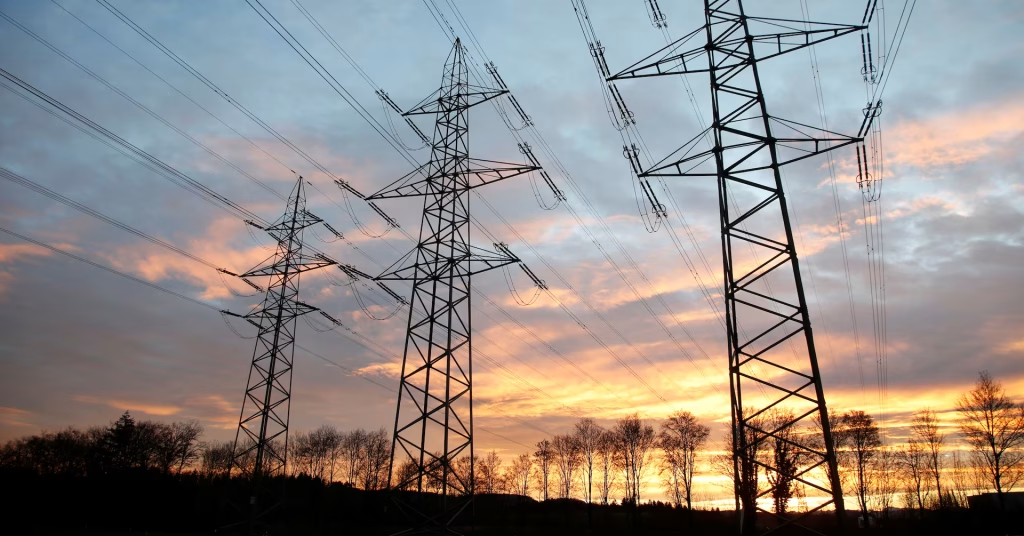
Libya’s electricity system depends heavily on a continuous flow of fuel from the country’s hydrocarbon sector. Any disruption in fuel deliveries can rapidly affect generating capacity.
This creates a chain of vulnerabilities. Political disputes can disrupt production. Protests can interrupt transportation routes. Technical failures can reduce output. Security incidents near energy infrastructure can create operational delays.
The country’s energy sector has demonstrated resilience over the past several years, but it remains exposed to recurring instability. Oil fields, pipelines, storage facilities, and export terminals continue to operate within a fragmented political environment.
While large-scale attacks on energy infrastructure have declined compared to previous periods of conflict, the underlying vulnerabilities have not disappeared. Libya’s electricity sector remains dependent on infrastructure that requires continuous protection and coordination.
This dependence creates a strategic challenge. Every disruption in the energy supply chain carries consequences far beyond the oil sector itself. It can ultimately affect households hundreds of kilometers away through reduced electricity generation.
Summer Demand Creates Additional Pressure
Electricity demand in Libya follows a predictable pattern. Consumption rises sharply during the summer months as temperatures increase across the country.
Air conditioning places enormous strain on the grid. At the same time, population growth and urban expansion continue to increase baseline demand.
Unfortunately, generation capacity has not always expanded at the same pace. The result is a system that often operates with limited margins during peak periods. Even relatively minor disruptions can have outsized consequences when the grid is already under pressure.
This dynamic helps explain why authorities are focusing on fuel supplies before temperatures reach their seasonal peak.
The challenge is not simply generating electricity. It is maintaining a stable flow of fuel, ensuring generating units remain operational, and managing demand during periods of extreme consumption. Failure in any one area can create wider problems throughout the system.
Criminal Networks Benefit from Weaknesses
Electricity shortages also intersect with another long-standing security challenge: fuel smuggling.
Libya spends billions of dollars maintaining fuel subsidies. These subsidies create large price differences between Libya and neighboring countries, generating strong incentives for illicit trafficking networks.
Fuel that should support domestic consumption often enters smuggling routes instead. Every liter diverted away from the formal economy increases pressure on state resources and complicates energy planning efforts.
Smuggling networks do more than create economic losses. They strengthen criminal actors, undermine state authority, and create alternative systems of influence in areas where government institutions already face challenges.
This connection often receives less attention than technical discussions about generation capacity or transmission infrastructure. However, it represents a critical part of Libya’s broader energy security landscape.
A country cannot fully secure its electricity supply if criminal networks continue to profit from weaknesses within the fuel distribution system.
Public Services Depend on Reliable Power
The security implications of electricity shortages extend beyond protests and economic losses. Critical public services depend on reliable electricity.
Hospitals require continuous power for medical equipment and emergency operations. Water systems rely on electricity for pumping and distribution. Telecommunications infrastructure requires stable energy supplies to maintain connectivity.
When outages become prolonged, these systems face increasing strain.
Backup generators can provide temporary solutions, but they are not a substitute for a functioning national grid. They also depend on fuel availability, creating another layer of vulnerability.
In security terms, resilience matters as much as generation capacity.
The ability of essential services to continue operating during periods of disruption often determines whether an infrastructure challenge remains manageable or develops into a broader crisis.
The Legitimacy Challenge
Perhaps the most significant security dimension of Libya’s electricity crisis involves legitimacy.
Citizens frequently judge governments based on their ability to provide basic services. Reliable electricity sits near the top of that list.
Political agreements, institutional reforms, and economic initiatives all matter. However, many citizens ultimately evaluate state performance through everyday experiences.
Can the lights stay on?
Can businesses operate?
Can families remain comfortable during periods of extreme heat?
These questions shape public perceptions more directly than many political debates.
For Libya’s competing institutions, electricity therefore represents more than a technical challenge. It represents a test of governance. Every successful summer strengthens public confidence. Every major blackout risks eroding it.
Looking Ahead
The recent coordination between the NOC and GECOL signals that Libyan authorities recognize the importance of preventing a summer electricity crisis.
That recognition is encouraging. However, short-term fuel arrangements alone will not solve the deeper issues affecting Libya’s power sector.
The country still faces aging infrastructure, growing demand, fuel distribution challenges, and persistent governance weaknesses. Addressing these problems will require sustained investment, stronger coordination, and long-term planning.
The immediate objective remains clear: keep electricity flowing during the months ahead.
Libya’s electricity system now sits at the intersection of energy security, public stability, economic performance, and political legitimacy. Future debates about national security will increasingly involve questions that once appeared purely technical.
The issue is no longer simply whether Libya can generate enough electricity.
It is whether the country can build an energy system resilient enough to support stability in an environment where infrastructure failures carry consequences far beyond the power grid itself.