Migration has long occupied a central place in Libya’s relationship with Europe. Policymakers, international organizations, and foreign governments often discuss the issue through the lens of border management, humanitarian concerns, and Mediterranean crossings.
Inside Libya, however, the debate has begun to change.
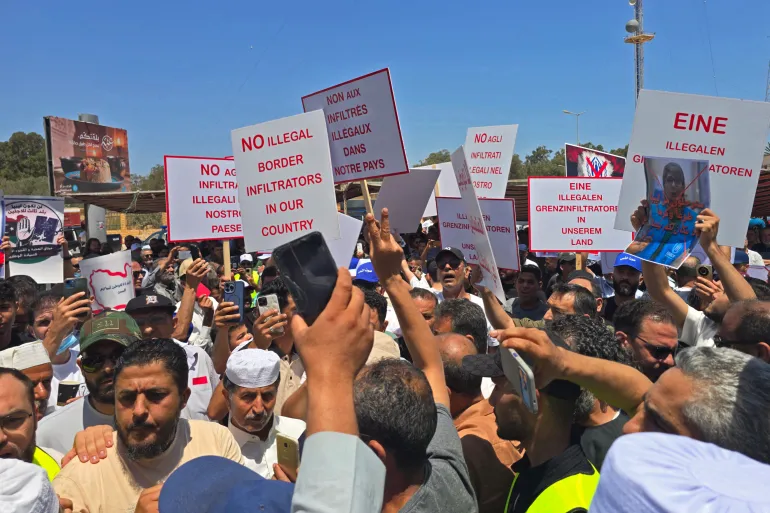
Recent anti-migrant protests in Tripoli and other parts of the country reveal a growing sense of public frustration over migration management, border security, and the state’s ability to control population flows. What was once viewed primarily as a diplomatic or humanitarian issue increasingly carries domestic security implications.
The significance of these demonstrations extends beyond migration itself. They highlight rising tensions between public expectations and institutional capacity. They also expose how migration has become intertwined with questions of governance, legitimacy, and social stability.
For Libyan authorities, this shift presents a new challenge. Migration is no longer only a border issue. It is becoming a national security issue.
From Transit Country to Domestic Political Issue
For years, Libya served primarily as a transit point for migrants seeking to reach Europe. Political discussions therefore focused on border control, human trafficking networks, and cooperation with European governments.
That framework no longer captures the full picture.
Many Libyans now view migration through a domestic lens. Economic pressures, weak public services, unemployment, and concerns over security have increased public scrutiny of migration flows. As migrant populations become more visible in urban areas, local grievances have become more politically significant.
The recent protests demonstrate this evolution.
Participants did not simply criticize international migration policies. They expressed concerns about state capacity, local security, and demographic pressures. Whether those concerns accurately reflect conditions on the ground matters less than the fact that they increasingly shape public opinion.
Perception often drives political outcomes.
As migration moves from a foreign policy issue into the center of domestic debate, it acquires a different level of political sensitivity.
The Governance Challenge Behind the Protests
The protests also reveal a broader governance problem.
Many Libyans view migration as another example of institutional weakness. They see a state that struggles to regulate borders, enforce laws consistently, and manage complex security challenges.
This perception creates risks.
When citizens lose confidence in formal institutions, they often seek alternative actors to address security concerns. In Libya, that dynamic has played out repeatedly over the past decade. Municipal authorities, local networks, and armed groups have frequently stepped into governance gaps left by weak national institutions.
Migration could follow a similar pattern.
If public frustration continues to grow, pressure will increase on local actors to take a more active role in migration management. That may improve short-term responsiveness in some areas, but it could also deepen fragmentation and create competing approaches to security governance.
The issue therefore extends beyond migration policy.
It touches on a fundamental question facing Libya: who provides security when state institutions struggle to do so effectively?
Armed Groups and the Politics of Migration
Migration has already become intertwined with Libya’s complex security landscape.
Various armed groups have participated in migration enforcement, detention operations, border security activities, and anti-smuggling campaigns at different points over the past decade. Some have cooperated with state institutions. Others have operated through more informal arrangements. This creates a complicated environment.
Migration management generates political influence. It attracts international attention. It can also provide access to resources, contracts, and external partnerships.
As public concern over migration increases, migration enforcement may become an even more valuable source of legitimacy for local security actors. That trend carries risks.
Security institutions should derive legitimacy from clear legal authority and accountable governance structures. When migration becomes a political issue, competing actors may attempt to position themselves as the most effective defenders of local interests.
Such competition can complicate coordination efforts and blur the line between formal security policy and political messaging.
Libya has experienced similar dynamics in other sectors. Migration now appears increasingly vulnerable to the same pattern.
Why Public Sentiment Matters
Migration debates often focus on statistics, border crossings, and international agreements. Public sentiment receives less attention. That may prove to be a mistake.
Public perceptions influence security conditions even when they differ from official assessments. If communities believe migration contributes to crime, economic pressure, or declining public services, those beliefs can shape political behavior regardless of the underlying data.
The recent demonstrations suggest migration has reached that stage in parts of Libya. The issue now resonates beyond policy circles. It has become a topic of public mobilization.
This development creates new pressures for policymakers. Ignoring public concerns risks further frustration. Overreacting risks creating policies driven by emotion rather than strategy.
Effective governance requires a balance between the two. Authorities must address legitimate security concerns while avoiding measures that create additional instability or undermine Libya’s international obligations.
That balance becomes harder to maintain once migration becomes a politically charged issue.
The European Dimension
Europe remains a major factor in Libya’s migration landscape.
European governments continue to view Libya as a critical component of Mediterranean migration management. Cooperation on migration therefore remains a central feature of Libya’s relationships with several European states.
However, European priorities do not always align with domestic political realities inside Libya.
European policymakers often focus on reducing irregular migration flows toward the Mediterranean. Libyan communities tend to focus on local security conditions, public services, and economic pressures.
This difference matters. Policies designed primarily around external objectives may struggle to gain domestic support if local populations perceive that their concerns receive insufficient attention.
The recent protests highlight that risk. Migration management strategies that ignore domestic political dynamics often become less sustainable over time. Public frustration eventually forces policymakers to adapt or face growing opposition.
For Libya, maintaining that balance will become increasingly important as migration remains a prominent issue on both domestic and international agendas.
A Security Issue That Will Not Disappear
The anti-migrant protests reflect deeper structural realities rather than a temporary political moment.
Libya sits at the crossroads of major migration routes. Regional instability, economic disparities, and ongoing conflicts across parts of Africa ensure that migration pressures will continue for the foreseeable future.
At the same time, Libya faces its own governance challenges, economic difficulties, and security concerns.
These factors intersect in ways that make migration increasingly difficult to separate from broader questions of national stability.
The challenge facing Libyan authorities therefore extends beyond border management. It involves building public confidence, strengthening institutions, improving coordination, and maintaining social cohesion in a highly polarized environment.
Those are security objectives as much as policy objectives.
Conclusion: Migration Has Entered Libya’s Domestic Security Debate
For years, migration occupied a unique position in Libya’s political landscape. The issue generated international attention but remained largely disconnected from broader domestic debates.
That separation is beginning to disappear.
Recent protests indicate that migration has become a visible and politically sensitive domestic issue. Public frustration, institutional weakness, and competing security actors have combined to transform migration from a border management challenge into a broader governance and stability concern.
This does not mean Libya faces an immediate security crisis linked to migration.
It does mean that migration now occupies a different place in the country’s political and security environment.
Future discussions about migration in Libya will no longer focus solely on borders, trafficking routes, or European policy. They will increasingly focus on governance, legitimacy, and the state’s ability to respond to public concerns. That shift may prove more significant than the protests themselves.