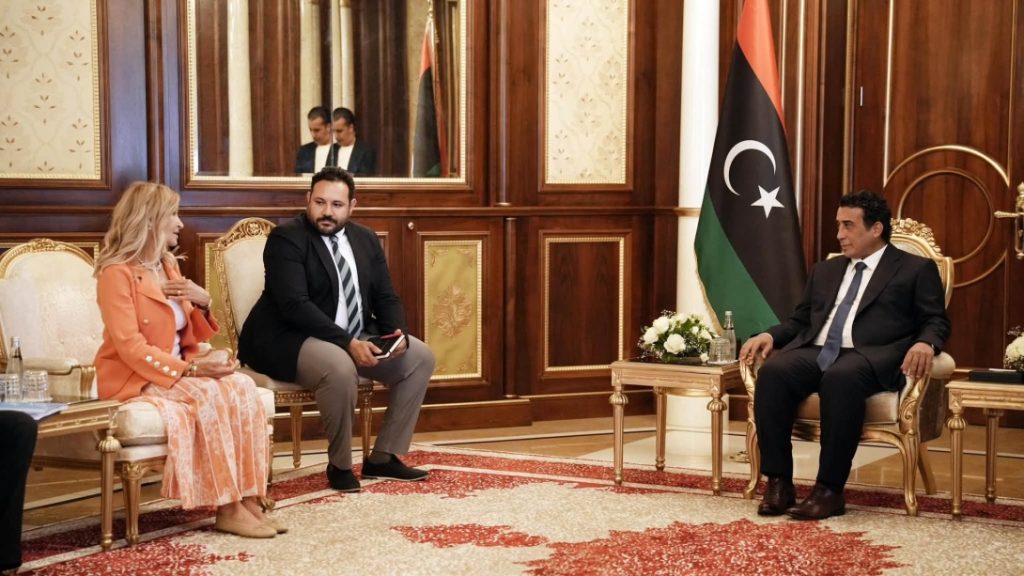
Libya’s Presidential Council Head Mohamed al-Menfi received a Swiss Foreign Ministry delegation in Tripoli on Monday. The meeting took place at the Presidential Council headquarters and focused on political stability, migration, human rights, and national reconciliation.
The Swiss delegation included Monika Schmutz Kirgöz, Head of the North Africa and Middle East Division at the Swiss Federal Department of Foreign Affairs, and Switzerland’s Ambassador to Libya, Josef Philipp Renggli. Several diplomatic officials also attended.
The meeting reflects a broader pattern. European states now approach Libya through a security-first lens. Switzerland follows this trend, but with a more discreet and mediation-oriented strategy.
Switzerland’s Quiet Role in Libya’s Security Architecture
Switzerland does not play a military role in Libya. It does not compete for influence like larger EU states. Instead, it focuses on three core tracks.
First, migration governance. Second, human rights monitoring. Third, conflict mediation and reconciliation support. This approach aligns with Switzerland’s traditional neutrality. It also aligns with Libya’s current political needs. Libya remains divided between rival institutions. Security fragmentation continues across western, southern, and eastern regions.
Swiss diplomacy often operates in this gap. It avoids public confrontation. It prefers technical engagement with institutions such as the Presidential Council. In the Tripoli meeting, migration management stood out as a central issue. Libya remains a key transit hub for migrants crossing the central Mediterranean. European states continue to prioritize Libyan cooperation to reduce irregular flows.
Switzerland participates in this framework through EU-aligned policy coordination and humanitarian support channels.
Migration Pressure Shapes European Security Policy Toward Libya
Migration remains the dominant security issue linking Libya and Europe.
Libya’s coastal route continues to serve as a major departure point for migrants heading toward Italy and Malta. Instability inside Libya increases the activity of smuggling networks. Armed groups also exploit migration routes as sources of revenue. European states now treat migration as a core national security issue. Switzerland follows this trend through diplomatic and humanitarian tools.
The Tripoli meeting reflects this reality. Discussions included illegal migration control mechanisms and cooperation frameworks.
However, Libya’s fragmented governance limits enforcement capacity. The Government of National Unity controls parts of western Libya. Rival authorities maintain influence in the east and south. This division complicates border security coordination. Switzerland’s engagement focuses on supporting institutional capacity rather than enforcement operations.
Human Rights and Detention Systems Remain a Core Concern
Human rights formed another key agenda point in the Tripoli discussions.
Libya’s detention infrastructure remains under international scrutiny. Migrants and refugees often pass through detention centers controlled by state and non-state actors. Conditions vary widely. Oversight remains limited.
Switzerland consistently emphasizes legal protection frameworks in its foreign policy. In Libya, this translates into advocacy for detainee protection, legal reform, and humanitarian access. However, human rights diplomacy in Libya operates within a fragile environment. Security institutions remain divided. Accountability mechanisms remain weak.
This limits the scope of reform. It also increases the importance of diplomatic engagement with central institutions like the Presidential Council.
Swiss Support for Libya’s National Reconciliation Process
The Swiss delegation also discussed Libya’s national reconciliation process.
This remains one of the most sensitive political tracks in Libya’s transition. Since 2011, Libya has struggled to build a unified political settlement. Multiple governments, militias, and armed coalitions continue to operate across the country. The Presidential Council plays a symbolic and institutional role in reconciliation efforts. It acts as a head-of-state body under the Libyan Political Agreement framework established in 2015.
Switzerland supports reconciliation through mediation expertise and dialogue facilitation. It often works behind the scenes. It avoids direct political alignment with Libyan factions.
Instead, it promotes structured dialogue between communities, political actors, and civil society groups. This approach reflects Swiss diplomatic tradition in conflict mediation environments, including past roles in Balkan and African peace processes.
Libya’s Fragmented Security Landscape Shapes Foreign Engagement
Foreign engagement in Libya increasingly reflects the country’s fragmented security reality.
Three major power centers continue to shape the environment:
- The Tripoli-based Government of National Unity in the west
- The eastern administration aligned with Benghazi authorities
- Southern Libya’s localized armed and tribal structures
This fragmentation forces foreign states to adopt flexible engagement strategies. Switzerland’s approach avoids alignment with military actors. Instead, it focuses on state institutions recognized under international frameworks, including the Presidential Council and UN-backed mechanisms.
This reduces political exposure. It also allows Switzerland to maintain access across competing Libyan centers of power.
European Security Interests Extend Beyond Migration
While migration dominates headlines, European engagement in Libya also reflects broader security concerns. Energy infrastructure, maritime security, and regional stability all shape policy decisions.
Instability in Libya affects the central Mediterranean. It influences shipping routes, offshore energy assets, and counterterrorism operations across the Sahel. Switzerland does not directly engage in energy geopolitics in Libya. However, it monitors regional stability risks due to their impact on European economic security.
This makes Libya a strategic observation point in Swiss foreign policy, even without direct economic stakes.
Libya’s Political Transition Remains Unresolved
Despite repeated diplomatic initiatives, Libya’s political transition remains stalled.
Elections remain delayed. Institutional unity remains weak. Security coordination between rival administrations remains limited. International actors continue to engage through parallel channels. The United Nations remains the primary mediator. European states, including Switzerland, support these efforts through complementary diplomacy.
The Swiss engagement in Tripoli reflects this long-term strategy. It does not signal a new political initiative. Instead, it reinforces ongoing international support for stabilization frameworks.
Regional Implications: Switzerland Positions as a Neutral Security Actor
Switzerland’s Libya engagement fits a broader regional strategy.
In North Africa and the Middle East, Switzerland positions itself as a neutral facilitator. It avoids geopolitical competition. It focuses on governance, humanitarian protection, and dialogue support. In Libya, this approach gives Switzerland limited but stable access to political institutions.
It also allows Switzerland to operate in coordination with European partners without direct alignment to military or geopolitical blocs. This makes Switzerland a niche but consistent actor in Libya’s complex diplomatic landscape.
Conclusion: Incremental Diplomacy in a Fragmented Security Environment
The meeting between Libya’s Presidential Council and the Swiss Foreign Ministry delegation reflects incremental diplomacy rather than major policy shifts.
It highlights three key realities: First, Libya remains a fragmented security environment requiring sustained international engagement. Second, migration and human rights continue to dominate European-Libyan relations. Third, Switzerland maintains a quiet but structured diplomatic role focused on mediation and institutional support.
As Libya’s political process remains unresolved, such engagements will continue to shape the country’s external relations.
Switzerland’s approach shows a consistent model: low-profile diplomacy, high-focus on stability, and long-term engagement in conflict-affected regions.